Sunday, June 27, 2010

Exit North


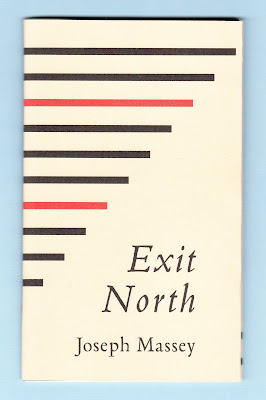
Exit North, Joseph Massey’s new chapbook from Book Thug in Toronto, is his third little publication – following The Lack Of and Mock Orange – since Areas of Fog, his early 2009 (and first) full-length collection (which itself followed seven chaps).

Go Joe Go! With his love of the little book, and the rate he shares his work with the world, Massey might just reach – if he keeps on keeping on – the publication numbers of a, say, Cid Corman (more than 100 books and pamphlets) or Ted Enslin (approximately 70 so far). I say, bip, bop, bam alakazam may it come to pass if that’s what he wants!

I read an earlier version of Exit North about a year ago, via a pdf direct from Massey, and really liked it. The final published version, compared to that which I previously saw, adds two poems, slightly re-arranges the poems’ order, and changes – all to the end of a tighter focus – a few words in a few poems. The chap has 31 pages, 22 poems, and is smartly designed. It costs ten bucks (plus mailing), and is published in a first edition of one hundred copies.

Exit North is yet another Massey gem. It has the great little poems you’d expect from him, plus – and this here is some news – several (I count seven) poems which while still small and short relative to most poets’ work, are quite extended for Massey.

In last year’s Areas of Fog, which collected work from the previous five or six years, there were but two poems among its several dozen poems with more than 50 words (the longest had about 80), and those were extreme outliers. Most Massey poems are 20 or 30 words long, or thereabouts, and many have far fewer (for example, the poems in Brambles, a chap entirely included in Areas of Fog, are almost all 12 words or less).

Given that history of extreme concision, it’s quite notable that several poems in Exit North have around 50 or more words, and it’s huge that one of them – “A Line Made by Walking” – has 120 words and is thus I believe the longest poem Massey’s ever published. No, Joe hasn’t gone epic with his verse, not yet at least, but in this chap he does significantly lengthen some of it.

The other part of the story regarding the longer poems in Exit North is that they are just as gem-like as the shorter ones. I discuss a couple of the longer poems below so maybe you’ll see a bit more then but in the meantime I hereby conclude that the shorter and longer poems differ only in that the latter – as a logical consequence of the added words – have more facets, or a deeper vividness, to fascinate the reader.

+(+)+

If you’ve read Massey, you know he writes from where he’s at, and that a part of where he’s “at” is the North Coast of California, up around Humboldt Bay, where he’s lived for several years. I’m a sucker for that area, having traveled through there a lot – more than 50 times – between 1993 and 2007 and on several occasions since then. I can’t prove anything, but my mechano-receptors and synapses seem to ignite when I’m up there. Maybe it’s the salted air, the rush and recede of the sea, the fog and sun locked in the redwoods beneath a sky that moves, the bark of the sea lions and blasts of wind, or some other who-knows-what geodetic phenomenon, but when there that place kick-starts in me a mania of huge awareness, and vision gets mighty keen.

Exit North, reading it, gives me much the same gift of renewed (in)sight. It’s the place in the poems that does it, sure – the North Coast comes through, strong, via details regarding the qualities of its light, climate, flora, and geography details, but mostly it’s the Massey in the lines: his concision, precision, sound-sense, and the way the self, his mind-self, comes in. I’ve written about all that, or most of it, before, click here, here (scroll down a bit), and here if you please. For this post I’ll just say that Massey has an awesome thoughtful poetic awareness of what’s in his mind and of his emotions, as well as of the world around him, and it all comes through, beautifully and memorably in his words.

Sometimes, as in “After Last Night’s Drinking,” with its “patternless patterns,” “a child’s chalked hieroglyphics,” and “the noon siren” – plus other vivid details – Massey’s sober clarity is almost jaw-dropping. That there is a one hell of a hang-over poem: just about the whole goddamn bleezy perceptual-visual struggle – thoughts that “refuse,” “misremembrance,” things that “dissociate” or “blend” or “blur” – throbs through its 17 lines.

Also wondrous is “The Process,” which at just under 50 words is one of the longer poems in the book. Yes, it’s about poetry, the writing of it, and the waves in the mind, the crests and troughs of the world and one’s perceptions that come through in doing it, and which sometimes swamp the verse-work. Like just about every poem in Exit North, I’ve read this one over and over about fifty times and still find it something. Here it is, with its title and six tercets:

The Process

Cross-stitched
outside sounds
double the day’s

indoor confusion.
How to untwine
noise, to see.

There’s the bay,
highway slashed
beneath; water

a weaker shade
of gray than this
momentary sky’s

widening bruise.
The page turns
on the table, bare

despite all
I thought was
written there.

This poem is tight, and there are many points of accomplished genius. Start with the first sentence, which runs through the opening tercet and the first line of the second, and which in its few words contains multitudes of stuff. True, complications come about from the multiplication in the action-verb “double” in the third line, but that’s also there at the top, in the first line’s compound “cross-stitch,” an adjective that substantively highly suggests complication, and with its rich sounds (the “s’s,” “c’s” and “t’s”) make audible and thus pair perfectly with the “outside sounds” which it modifies. Then there is the quickness – an effect that results from Massey’s compression and concision – with which those “outside sounds” double up the “inside confusion.” My goodness, how much comes through in all that?

The language energy surge strong through the lines that follow that opening. The two lines that follow set out the central challenge: how to achieve clarity, to focus, amid all that’s about. The verb “untwine” seems particularly apt; it picks up on the “cross-stitched” and I think on “double” too, via the “untwin” embedded in it.

Massey then lays out a complex sentence that begins at the first line of the third tercet and runs to the first line of the fifth, and it kills. You can read it just as well as anyone; I love how he brings in the bay, highway, water, and the transitory (via “momentary”) sky with its “widening bruise” with nary a wasted word, and the way a kind of connected implicit violence comes through via “slashed” and “bruise.”

And then ladies and gentleman there is the parallel construction of the stanza-jumping, sentence-ending, two-word combinations that comprise the first lines of the second and fifth tercets. These enjambments create a kind of non-rhyming rhyme that brings together the “indoor confusion” and “widening bruise” in the lines.

The final sentence, comprising the poem’s last five lines, is a relatively simple statement about what’s not on the page, and the poet’s misapprehension about what isn’t there. I like the kind of tromp l’oeil effect, or is it the reverse of that? It’s not three dimensions depicted by two, but nothing (the “bare” page) shown by something (the final lines of “The Process”). Massey the Magnificent does it again.

+(+)+


A Line Made by Walking (1967)
Richard Long

The centerpiece poem of Exit North – it begins on the right side of the book’s middle – is “A Line Made by Walking.” Massey in an endnote states that his title is taken from Richard Long’s work.

Long’s work is a conceptual and process piece (documented by the photograph above) which he made by repeatedly walking a straight line in a grass field. He made his own path, going nowhere in particular but exploring relationships between time, distance, geography and measurement. The final product, the worn path and its documentation, is a sculpture of place, a distillation of experience.

Massey’s poem visually echoes Long’s work. It has 21 couplets, plus a concluding single line, and all lines are very short, with the longest having four with most having just two or three words. The thing, as it proceeds with its little steps, looks like a path made with words down its three pages. Here are the first half-dozen couplets:

Humid June
air that barely

moves, and yet
the water in the

creek wrinkles,
pushed around

fronds and
broken bottle,

or is it
chipped quartz

trapping the
glare. Rusted

[. . . ]
Notice that the sentence and line ends here are not congruent, keeping the poem moving. Note too how the two adjectives in the first line (“Humid June”) work both as a stand-alone concept and (due to the absence of a line ending comma) as a double modifier for “air” in the next line. But see most of all how the excerpt here looks on the screen, and imagine that relatively narrow column of words continuing for a couple more pages: a path made by lines stepped (walked) out by the poet, one after another.

I mentioned above that “A Line Made by Walking” is the longest poem Massey has published. And now that you are curious, I will not share any more of it here. You are going to have to buy the book, and you will do that, yes?

Interestingly, the 120 words of “A Line Made by Walking” do not read “long,” even for a Massey poem. The couplets move along smartly, and the mind never gets stopped by a word that’s not right, or out of place, because Massey’s concision, sound-sense, and poetic way with words never flag. There is plenty at which to marvel. And while the lines are essentially uniform in length, the six sentences embedded in them are not. The sentence-length pattern (long-medium-short-long-short-long) varies the poem’s pace, and that keeps attention taut.

It all raises the question of how long through the pages Massey might want to go. “A Line Made by Walking,” and the other more extended than usual poems in Exit North suggest he could write longer poems, without losing the gem-brilliance that marks his work. Well, to repeat what I wrote above, bip, bop, bam alakazam may it come to pass if that’s what he wants!

+(+)+


+(+)+

+(+)+
+++(+)+++
+(+)+


Sunday, June 20, 2010

“ . . . storms and

diatribes. Truffles and diamonds. Fables and ferns.”


John Olson’s recently published The Nothing That Is – a putative “novel” that’s in fact an autobiography written in the second person – shows again why I’ll follow him – his writing – anywhere. What an engaging and fun 150 pages, and oh the bits about poetry, and oh the poetry in the prose!

Because it’s written in the second person, The Nothing That Is comes across as a book that’s about you, the reader, while of course it’s really about Olson, the writer. The constant effect is to get you, the reader, to think about whether you agree with what’s said about you, and thus to get you (the reader) right there next to Olson’s views, experiences, and ways with words. Here are four paragraphs from very early on:
            You find bark grandiloquent with texture, like skin.
            You once enjoyed imbibing spirits but they got the
better of you, and it was either bid them goodbye, rid them
from your blood and being, or become a blob of mucous and
protoplasm erupting in vituperation at invisible interlocutors.
            You hate cars. They are destroying the world. But you do
love your own car, which is small and red.
            You have never seen an armadillo on a Texas highway
because you have never been to Texas, but you have seen deer
trot across a dirt road in North Dakota, an owl swoop down
against a red sunset in eastern Washington, a hawk circle a
meadow of cottonwood and poplar with the Wasatch range in
the background, and a fish of unknown identity leap, suddenly,
from Moses Lake on a bright summer afternoon.
See what I mean? What do you think, how do you feel, about, bark, drinking alcohol, and cars? What animals, birds, and fish have you seen while driving? How would you put those thoughts and experiences in words? Olson in this way strongly exploits the implicit second person narrative tone, not so much the accusatory facet of that, but that which places the reader in unfamiliar or new circumstances. Throughout the book, you are there, with him, in his life. It’s invigorating, and of course also banishes entirely the “I” which egotistically grates in many autobiographies.

The Nothing That Is was written and mostly covers events over several months in 2006, although naturally enough much from Olson’s past gets mentioned or recounted. As such, you’ll learn a bit about his mom and dad, how he met his current wife, and the details – strangely fascinating – of how he waits for her to get off work in the parking lot of the supermarket in which she decorates cakes. You’ll find out what he thinks about SUVs, hip-hop, apathy, noise, his neighbors and a hundred other things. You’ll read about the time in 1966 he bought Jimmy Page (yes, that Jimmy Page) a Coke, the habits of his cat, and the invasion of carpenter ants in the building where he now lives. Digressions musing on, for example, the postman’s hands, the car Montaigne would drive, the full moon in the daytime sky (Jack Spicer comes into that one), and how resignation can be a wonderful thing. All this, as they say, and more. In short, if you want to get to know John Olson – and heads up to those in New York City, he has a Poetry Project reading coming up this fall – this is one tremendous introduction.

The Nothing That Is mostly takes place in Seattle, where Olson has lived for decades, but there’s a great 35 page swath just after the middle of the book – so engaging it almost serves as the novel’s centerpiece – that concerns a road trip to Missoula, Montana. Also, while place names remain true to the actual, most people mentioned are given swapped out names, in the manner of a roman à clef. However, some of these – such as Olson’s wife, and the poets Andrew Joron and John Yau (for whom Olson provides tremendous capsule descriptions of their writing) – are fairly easy to decode.

The book’s title comes from the final words of Wallace Steven’s great poem, “The Snow Man” (the poem’s set out in full opposite the first page). I can’t here fully boil down Olson’s concept of “the nothing that is” but it does – per what’s in the book – relate to Zen no-mind:
            You try not to make judgments but focus intensely
and openly at what is there, there in its actuality, there
without any overlays of personal value, skewed perceptions.
The dimming light of late afternoon in late winter, the yellow
arrows of the parking lot, one curving round the other two
pointing straight ahead, the imperceptible changes in the
clouds, the crown of the Space Needle poking above Fed
Ex Kinko’s, the light distortions of repaired dings in the
windshield, the diamond pattern on the wall of the drugstore, a
flock of seagulls, the pliable indentations in the steering wheel
that are nice to squeeze, you absorb yourself in all these things
and try to bring some peace into your body, some detachment,
some compassion, not to have any thought stirred by the
outside conditions of life, good and bad.
Sort of the flip side to this no-mind ideal is anger and rage. Olson has his moments this way, and those moments are INTENSE. The upstairs neighbors are particular focal points, and at times it scares me how mad Olson gets (the provocation can be severe). Olson never acts on what goes on in his mind, questions sincerely and smartly the hows and whys of it, but if his thought-dreams could be seen, they would indeed probably put his head in a guillotine. It’s pretty courageous, I think, for Olson to show this much of this part of himself.

Among all else in The Nothing That Is are several passages directly about writing, and the writing of poetry in particular. Olson at one point in the book just comes right out with it, stating in no uncertain terms what it is he’s looking to do with poetry, and how it differs from what else is out here:
              [ . . . ]        You favored a type of poetry that
was wild and surreal. A poetry full of phantasmagoria and
fugitive meaning. The poetry of delirium. A poetry that did
not point in one direction but in many directions. A poetry
that capitalized on the inherently hallucinatory properties
of language. It had been your experience that most people
did not care for this type of poetry. People preferred a more
transparent poetry which presented a single lyrical emotion in
an anecdotal setting. The bland and acceptable poetry which
was generally featured on NPR, read by Garrison Keillor, and
got all the NEA grants.
Olson a bit further along also describes his approach in an equally tasty, but perhaps more bite-sized set of two sentences:
[ . . . ]    Writing things that do not instruct or inform so much
as diffuse into the blood and nervous system creating feelings
of disquiet and euphoria. The sound of heaven made actual as
skin.
And then, also further along, there is the following passage that’s a bit – make that a lot – more tactile and poetic, and thus which while explicating the approach to writing also imparts the wonder that comes when Olson works the words right:
            Your day is a long monologue. Words galore. Your pen
is a leopard moving with stealth through a lush vocabulary of
brawling vines and exotic bullfrogs. You are Prospero with his
staff. You conjure storms and diatribes. Truffles and diamonds.
Fables and ferns. The machinery of signification. Monsters of
howling malcontent. Maraschino dots like scabs of coagulated
thought.
Storms and diatribes, truffles and diamonds, fables and ferns. Hmmm, and yes, I think that, the series of coupled nouns there, just about covers it, says just about exactly what you’ll find in The Nothing That Is, a novel autobiography that’s everything I hoped it would be.

+(+)+

“The Snow Man”
by
Wallace Stevens


[recited by James Merrill]

+(+)+

John Olson regularly posts his reviews and prose poems at Tillalala Chronicles. Other recent prose poems by Olson are posted at Alligatorzine. I’ve previously published Olson’s essays on, respectively, aliteracy, extreme reading, and hard-copy books, and have previously written on Olson’s non-literary essays, his poetics, and his most recent poetry collection, Backscatter. Another collection of Olson’s poetry, titled Larynx Galaxy, will be published late this summer by Black Widow Press.

+(+)+
+++(+)+++
+(+)+


Wednesday, June 16, 2010

. . . and

yes

I

said

yes

I

will

Yes.


Saturday, June 12, 2010

The Return of Ron . . .

. . . to Poetry


Ron Silliman
“from
Revelator
in
Poetry
(June 2010)
[cover image altered, natch, via PhotoShop]


Well, what do you know: this month, after an absence of 41 years, poet Ron Silliman’s work – in the form of a long excerpt from his poem Revelator – appears again Poetry magazine. Silliman’s previous and only other appearance in the ‘zine came in 1969, the year his first book was published.

No, nobody’s going to write an epic, a la Odysseus and Penelope, about this particular return. Nor is Silliman here some sort of poet Tommy Thevenow, the major leaguer whose first home run in 1926 was not followed by another until 1938, 12 seasons and 3,347 at-bats later (that’s the record); Ron’s had plenty of round-trippers over the decades. But still, this may be the record, or close, for most years between appearances in the grand dame of American poetry magazines.

Anyway, I wanna talk about “from Revelator,” the Silliman poetry that Poetry published. It’s ten excerpts, amounting to approximately 465 lines (each with exactly five words) and 14 printed pages in the hard copy ‘zine.

But first, permit me dear readers of the glade to opine a bit regarding the po(etry)litics – by which I mean the significance – of Silliman being published in Poetry after so many years. It’s come about, I think it fair to say, as a result of Poetry’s recent move towards a more catholic approach to the possibilities of today’s poetry. For a long time – some would say since Henry Rago was editor (he died in 1969) and at least the last approximately 20 years – Poetry, the work published in it, has been – with a few notable exceptions (e.g., John Ashbery) has been decidedly uncomtemporary (as Silliman himself implied three years ago) and (my term here) awfully dull.

But in the last three years or so Poetry has broadened what it publishes. Poets and poems that you wouldn’t (and couldn’t) find in it twenty, ten, or even five years ago now appear just about every month. Look who has turned up in the ‘zine since 2007 or thereabouts (these are examples): Rae Armantrout (in five different issues), Fanny Howe (a couple times), a bunch of Flarfers + Conceptualists (a special section), Charles Bernstein (thrice), Ange Mlinko (a dozen or so separate time, a laudable instance of editorial enthusiasm unleashed), Inger Christensen, Robert Hass (the longish + disjunctive “September Notebook: Stories”), Juliana Spahr (a manifesto), and a large number of vis-po work (another special section, edited by Geof Huth).

As such, this month’s – drumroll, please – Return of Ron continues the magazine’s attempt to become a forum for new work from poets who write in ways decidedly different than the quieter staid verse that it primarily and even entirely featured in far too many issues for far too many years.

For this most welcome change I credit senior editor Don Share (he began at the ‘zine in October 2007), his boss Christian Wiman (who seems to have given Share room to move), and associate editor Fred Sasaki (who no doubt does a lot of the work). But whoever has made it happen, I celebrate the move towards presenting writing of a kinds different than its own recent tradition, to take a course that might (or plainly will) cause concern among that part of Poetry’s subscriber or readership that’s too often been inured to the fuddy-duddy.

Yes, “inured to the fuddy-duddy.” That’s what I say about those who – to take just examples from readers’ letters published in Poetry so far this year – find an esoteric allusion “solipsis[tic],” deplore “gutter language and “naughty children,” consider themselves “average Joes,” believe that poetry now finds itself in a “lowly state,” or find ampersands and “Dickinsonian dashes” distracting.

Hello? Dear people inured to the fuddy-duddy: wake up, please, and smell the kaliedoscope as it tickles your proprioception!

Now don’t get me wrong. Poetry’s recent efforts to expand its variety is but a start. There are at least fifty other poets – and that’s just off the top of my head – that should be published there, before the ‘zine can righteously be considered to have approached the wondrous range of today’s out-there and with-it writing. I hope Poetry’s editors actively solicit wide and far, and that poets I’m thinking about give it a shot.

Poetry, let’s face it, is well-positioned to attract poets of all kinds, in that unlike many journals it pays, and pays relatively well. At its standard rate of ten dollars per line, Silliman for example presumably received close to $5,000 for “from Revelator.” That’s a nice chunk of cash (although given the length of the excerpts, and their placement at the front of the issue, I hope Poetry applied a generous multiplier to Silliman’s payment). The Poetry Foundation has the money, and if they can build a $25 million headquarters and a million dollar website they can kick down a little more to the poets. So, go Poetry: keep paying the poets, and please: less pap, more inventive and visionary.

Poetry it seems to me is trying to become a kind of monthly big-tent three-ring verse-circus (and don’t forget the prose-poets, please). This is not a bad goal, it sounds fun as hell, but whether this can work or not in practice, I’m still not sure. Sometimes it’s really, really weird. Next month’s (July/August 2010) issue, whose table of contents and one essay are already available on-line, shows what I mean. It includes among other things two poems by the fresh, neo-surrealist, and riveting Sandra Simonds, to which I say yes!, and a poem by Anthony Madrid titled “In Hell the Units Are the Gallon and the Fuck” that I’ll wager will be a very lively read.

But next month’s Poetry will also include a portfolio of work by Robert Pinsky about which, sorry, I’m betting will strike me as populist doggerel [note: on 6/14, I learned via a blog post by Poetry editor Don Share that it’ll be a libretto, not poems by Pinsky]. Even worse, Poetry will feature an essay – I call it a stink-pile – on poetry by John Wooden, the just-dead ultra-conformist college hoops coach. The essay is already on-line (click here, but I warn you), and in it Wooden explicates a view of poetry as interesting and useful as a deflated basketball. Hallmark greeting cards are better than the verse quoted by Wooden in the essay. Crap like this shouldn’t be allowed in any tent, no matter how big and no matter how much inventive and experimental work is included.

But let’s get back to Silliman’s “from Revelator.”

+(+)+

The 14 pages of excerpts from Silliman’s Revelator in the June 2010 Poetry amount to about 25% of the completed poem, according to information Ron kindly provided in response to an e-mail query. An interesting question, to me at least, is why were the particular poem-segments printed in the issue – and again, there are ten – chosen?

There’s little doubt that the excerpts were carefully selected. They are taken from different parts of the poem, and are not simply consecutive to one another (as can be deduced by listening to a reading by Silliman from earlier this year). Further, the excerpts vary in length. The longest is 84 lines (three others have more than 50), five have between 30 and 45, but one is but seven lines long. That short one got me started here – why those lines, and only those?, I asked myself – and from there the same but broader question: of everything in the poem, why these particular excerpts?

My answer is but a guess, a speculative assertion. However, I think it’s a good guess, and besides, by offering my two cents the poem, that which is at its core, can be focused on, which should be the main point here.

So here’s what I think: Revelator is a great poem, and the excerpts in Poetry were chosen
both because they are representative samples and include enough of Silliman’s core poetic / aesthetic / philosophical precepts (embedded in the lines) such that those new to his work – including that segment of Poetry readers that I call fuddy-duddies – might learn and see (assuming they give it a good honest read) what he’s up to as a poet, and might have their eyes and minds opened to its power and importance. The excerpts, in short, serve as a not quite but sort of a primer and/or prolegomenon to Silliman’s poetry, something that might be instructive to readers not yet familiar with it.

It’s “not quite but sort of” a primer because the principles presented even when overt are embedded in the lines, and sometimes presented as object lessons. But pointers about and examples illustrating what’s going on are there, and readers who don’t know Ron’s writing, who might be used to more explicitly narrative or bow-tied poems, are given plenty of signposts.

At the core of Silliman poetry – more accurately, the Silliman I’ve read over the years – is an intense focus on the present, the now. It’s something he learned first while working with prisoners in the early 1970s (see the note at the back of Circle “R” (Drogue Press, 1995), written in the third person but clearly Silliman’s own, and the section appended at the bottom of this post). For those doing time, yesterday and tomorrow aren’t nearly as relevant – to say the least – as today (this convict-view in Silliman deserves greater exploration, and someday I may well do so). The point though, is the NOW, and keeping the mind attuned to it.

And so in the first excerpt from Revelator in Poetry, a few lines into it, there’s a mention of a movie, about which Silliman writes:
              . . . plot too
dense to follow, unless (unless!)
mind’s eye gives attention . . .
And there it is, the importance of attention, a pretty dang direct mention at that, and emphasized too, via the repetition and exclamation-pointing of the qualifier-conjunction.

And so too, in one of the later excerpts (I’ve added italics here is underscore my reference):
                  . . .young man
alone in Chipotle, chewing thoughtfully
his large burrito, not talking
taking it all in, eyes
absorbing all, could have been
had this taqueria been there
then, myself in 1964 . . .
I like the repetition of “all” in this excerpt, in that it again emphasizes the goal, the approach of the poet, and the fact that the principle set forth – Silliman’s thinking about what’s going on, his projection of self into the observed – is embedded in a detail (the guy with burrito), an instance of exactly the kind of particular that results from the focus on the now, and a detail and principle that – because it is presented in six concise and carefully constructed but almost nested-in-one-another clauses – requires from the reader the precise kind of attention that Silliman enacts and champions!

The “from Revelator” excerpts in Poetry also include lines and phrases in which Silliman comments about his process or approach, which also give the reader an orientation to his work. There is, for example:
                  . . . what’s near
is past too soon to
grasp fully the consequence, dawn
threatens a new day constantly
which seems to set forth the constant challenge of focusing on the now, and (this from the excerpt that’s but seven lines long):
              . . . —there’s an art
to it intuited before thought
thinks— . . .
which says something about how Silliman deals with the challenge of the cascade of moments. And then there’s this statement, the last example I’ll present (read the excerpts in Poetry, available on-line, to find more!), in which Silliman explains that his poetic adventure will never be finished and at the same time directly tells what he’s doing, as he does it (note the effect of the line break after “stretch”):
               . . . one project
I’ll not complete, that’s not
it’s point, but to stretch
even just a little, shape
& dimension, time & dominion,
+(+)+


“After [his] early books [Crow], nox and Mohawk, Silliman began to understand the most important lesson of his work with prisoners – that there is no time other than the present – and began to apply it to prose in a poem called Ketjak. This lesson and that project have subsequently extended into a life work, in which each poem is at once distinct and always also part of a much larger process.”
– from the editorial material near the rear of Silliman’s
Circle “R”
(Drogue Press, 1995)
(+)

“Tomorrow’s a dream
Yesterday’s a memory
Both a passing of a cloud”
– from “No Beauty In Cell Bars”
a poem by Spoon Jackson
in
About Time III:
A Third Anthology of California Prison Writing
(Prison Arts Project, 1987)


+(+)+
++(+)++
+(+)+


Saturday, June 5, 2010


Verser Pens Boffo H’w’d Slanguage Poem!

Today I give the o.o. (that’s the “once over” in the argot of the Daily Variety) to topliner Rachel Loden’s “The Hollywood Years,” a poem from her collection Dick of the Dead, which preemed a bit more than a year ago from Ahsahta Press.

Dick of the Dead is a book with legs. Almost a year ago I wrote about “Affidavit” from the collection, and then a few months later did a post about another poem in it, “I Know A Brand”. Others too have written about particular poems in the book, including Daisy Fried on “What The Gravedigger Needs,” Philip Metres on “The Toybox of My Intentions,” Joel Brouwer on “Milhous as the King of the Ghosts,” and Loden herself on “Miss October”). Reviews of the book as a whole also appeared steadily throughout 2009, including by Maureen Thorson, Susan Grimm, Tad Richards, Crg Hill, D.A. Powell, Douglas Barbour, Jeffrey Cyphers Wright, Joanna Fuhrman and Elaine Terranova.

In addition, Pulitzer-winner Rae Armantrout’s Attention Span 2009 list had Loden’s book at the top. Most recently, in March 2010, the Commonwealth Club named Dick of the Dead a finalist for its annual California Book Award.

I continue find and re-discover poems in Dick of the Dead that provoke heavy mitting. “The Hollywood Years” is a good example. It was something of a sleeper for me; I’d read and liked it, but now, I REALLY like it. The poem deserves a far higher Q rating” among poetry-lovers than it appears to have. So in the hope of making it a hotsy read, this post tubthumps for Loden’s rhymer (well, okay, it ain’t really a rhymer), and I think for good reasons.

Here’s the poem, right here on your big screen, with its socko slang, lexi-oddities and even a few of its regular ol
’ words hyper-linked for your click-‘n-go, mind-(en)light(en)ing pleasure:
The Hollywood Years

My elevator pitch is getting shorter and shorter.
I keep a trained mouse in my persqueeter
Since I have one, and since you don’t
Talk out of your neck till it asplodes.

These last spring days are merciless, yes/no
Will Bluto finally favor us with his blutorial
Or shall I just power up my do-me shoes
And tether down the antipodes?

So much scrumtrelescence, daddy-o.
There’s crab butter already on your whickerbill
And it’s not galumptious in the swankienda
But the kiss-and-cry area is getting full.
These word-lines, first and foremost, are one big guffaw-fest. Loden’s language – in the main a mix of slang, the unusual, and satire of the super-smart kind– just kills. And because it kills, it cues an endorpho-rush in the megaplex of your mind, and gets the thought-wheels gleaming. The poem’s the exact opposite – antipode, shall I say? – of a yawner. It opens the eyes and alerts the mind to the possibilities of language.

S-c-r-u-m-t-r-e-l-e-s-c-e-n-c-e, indeed!

And what’s the vibe in, coming from, the poem? H’w’d and its silver-screen projected reality as superficial yip-yap? Maybe so. And that leads to a big-time sense, underlying or pervading the poem, of sadness, opportunities missed, time passed. The persqueeter and whickerbill may be in play, but nothing is tippy-top or even okey-doke. The days are merciless and as the curtain closes the kiss-‘n-cry is filling up with folks who, having finished their strut-
‘n-fret sound-‘n-furying, now just wait for their scores.

But I can’t greenlight an A-Z explication on this one. I’ll leave that, I suppose, to the crix, though if you
’ve grokked something here, drop a note in the comments, okay? I’ll just call “The Hollywood Years” a whammo poem, and say that Loden’s a hell of a chantoosie, of the poet-scribbler kind.

And folks, for me today, that’s a wrap!

+(+)+


+(+)+

Rachel Loden
(along with Maxine Chernoff and Donna de la Perriere)
will read at
Moe’s Books, Berkeley,
Thursday, June 10th at 7:30 p.m.

+(+)+
+++(+)+++
+(+)+


Saturday, May 29, 2010

Eshleman’s Energy


“Tavern of the Scarlet Bagpipe”

a poem
by

Clayton Eshleman

from his new
collection:


Anticline
(Boston: Black Widow Press, 2010)

Vigorous. Intense. Potent.

That’s the kind of energy you’ll find, what I found, in Anticline (Black Widow Press, 2010), the latest collection of poems (at least his sixteenth) from Clayton Eshleman, whose first book was published in 1962 and whose poems, from what I read here, seem strong as – heck, stronger than – ever.

Anticline has approximately 175 pages and sixty poems, divided into three sections. The centerpiece – it occupies the middle of the book, between two sections of shorter poems – is “Tavern of the Scarlet Bagpipe,” a single 25 page, 13-part, approximately 750 line poem that comes with another 15 pages of supplemental prose (including an introduction and five appendices). The poem’s an opulent – deluxe, sumptuous – take on Hieronymus Bosch’s early 16th century triptych painting, The Garden of Earthly Delights.


The Garden of Earthly Delights

Eshleman’s poem takes its title from his term for a particularly rich image (it’s reproduced at the top of this post) found in Bosch’s painting. Atop a tavern in a hollowed out bone-orb there’s a small flag depicting – yes, indeed – a scarlet bagpipe; the flag-image echoes an identical-looking actual, large-sized instrument atop an adjacent disc. “Tavern of the Scarlet Bagpipe” is a cool sounding place, I gotta admit, and seems appropriate too as a title in that Eshleman in the poem suggests, among other things, that Bosch’s image concerns the:
Artist as tavern aslosh with the lightning of Dionysian over-reach,
    pickled melancholy . . .
+(+)+

“Tavern of the Scarlet Bagpipe,” its prose introduction explains, stems from Eshleman’s decades long fascination with Bosch’s painting. He saw the triptych in person in 1979 at the Museo del Prado in Madrid and ever since has hung reproductions on his workroom wall. He’s also collected and read books and articles on Bosch.

In late 2004, Eshleman enjoyed a month-long residency at the Rockefeller Study Center in Bellagio, on Lake Como, specifically to study The Garden of Earthly Delights via reproductions and secondary texts. He generated close to 100 pages of notes. Thereafter, he created almost 700 worksheets while writing and shaping the final version of his poem.

Eshleman calls this project “the most challenging thing” he’s ever taken on. Now that’s REALLY saying something, given that in addition to writing many books of his own poetry, Eshleman’s translated all of César Vallejo and (with others) Aimé Césaire, studied for decades Ice Age cave art and early human imagination (see his almost 300 page Juniper Fuse (Wesleyan, 2003), and for years edited the top-flight poetry journals Caterpillar (1967-1973) and Sulfur (1981-2000).

This whole deal – the decades of study and thinking, intense weeks of focused even extravagant wood-shedding, pages and pages of notes and worksheets, a motherfucker of a project finally coming to a finished creative work – is a most appealing kind of crazy, the kind of thing that can really put the poetry in a poem. Sure, sometimes a poem’s as easy as opening a floodgate and letting the waters flow.

But other times, it seems to me, it’s something entirely different. Materials must be gathered and aged, considered and mixed. Equipment, including flasks, beakers, funnels, pipettes, and condensers, plus heating and cooling apparatuses, must be obtained, set up, and tested. And then the experimenting and actual work begins, and only then, slowly over time, do ideas and language condense and distill into the words of poem.


1: Heat source / 2: Still pot / 3: Still head / 4: Thermometer/Boiling point temperature
5: Condenser / 6: Cooling water in / 7: Cooling water out / 8: Distillate [the poem] /
receiving flask / 9: Vacuum/gas inlet / 10: Still receiver / 11: Heat control
12: Stirrer speed control 13: Stirrer/heat plate / 14: Heating (Oil/sand) bath
15: Stirrer bar/anti-bumping granules / 16: Cooling bath.

O holy time-taking diligent (al)chemical poet obsessions!

+(+)+

Eshleman in “Tavern of the Scarlet Bagpipe” takes many approaches to, with, and from Bosch’s painting. He details many particulars, putting into words the awesome rush of the Garden’s visual imagery. He speculates, via assertions and questions, about what goes on in the work. He brings into the poem matters from outside the triptych, including a few events from recent times (for example, Salvador Dalí and Donald Rumsfeld appear), and imagined voices (Bosch himself speaks in one section), and much that’s self-reflective or of special concern to him. At a few points, Eshleman even puts himself right in the painting!

Eshleman, in short, writes of and about, into and out of, calling and responding to, The Garden of Earthly Delights. The art acts as subject, spur, and mirror. The poet gives life to the Bosch’s work, the work gives it right back to him, and we, the readers, ride the energy on both sides and in between. Eshleman gets close to what I’m saying, I think, when he writes at the end of the poem’s eighth part (which concerns the “Apocalypse” wing of the painting):
This flash frozen nightmare. It is the onlooker
who puts motion into Apocalypse. Expressionless males faces, dots
    or blotches where eyes should be. Who are they? Who am I?
This vision is a kind of mirror facing me, likewise a mirror.
                                                                 Between our banks
a drama surges, ripe with circular cease and wheel.


Ultimately, “Tavern of the Scarlet Bagpipe” presents no overarching conclusion about The Garden of Earthly Delights, because that’s just not possible. As Eshleman states in his introduction, “there is no core meaning to uncover” in Bosch’s painting. Or, as he elaborates in an appendix, “Bosch’s stupendous inventiveness plays havoc with an all-over theory. Spontaneous moves abound.”

The poem has a lot of this same feel. As the variety of its approaches – including the descriptive, speculative, inventive and reflective – suggest, Eshleman’s “distillation” (yes, that’s the word he uses, in the first section), contains much. Although the poem’s tightly constructed – each of its 13 parts pertains to an identified panel (or portion thereof of the triptych (including the reverse sides of the wings) or the painting as a whole – but within and across this architecture it sprawls. Sprawls as a healthy, vigorous plant or bush does, with branches, leaves, and flowers that extend, grow and bloom in ways not entirely predictable.

I can’t possibly, at least not right now, fully write about “Tavern of the Scarlet Bagpipe.” There’s lots in it, and I’m still digging Eshleman’s words and ideas (see the Addendum at the bottom of this post for some of what Eshleman himself sent my way after this was published). So today, I play - -for you, dear readers – a few choruses of “these are a few of my favorite things.”

+(+)+

I love first the poem’s many purely descriptive lines. They are concise and vivid. They bring to life Bosch’s jam-packed painted wonderland(s), the work’s multitude of hallucinatory, otherworldly dream-particulars. I could pair an image from the painting and Eshleman’s corresponding description, but instead I’ll just give the poetry because in this case the words are enough.

The excerpt below – it’s about two dozen lines – in the main describes a scene found in the middle of the central (or Paradise) panel of Bosch’s painting. Large numbers of animals, most ridden by naked men, parade around a small round pond in which naked women stand, stretch, or swim. Birds flit about or perch, often on a person’s or animal’s head, and many other beasts and people are seen as they too move from the sides into the circling multitude.

But that’s my prose. Here’s Eshleman’s verse, found in the poem’s fifth section. The excerpt begins shortly after Eshleman’s mentioned the “[t]hirty-one female nudes” who “cavort in the mother-elixir” (the pond or pool at the center of the scene). The view then pans out and zooms in on the “rotating cavalcade” trying to get the female’s attention:

    little red bear under a horse. Bud-like clusters of mainly nude male riders,
        all identical.
    A crow sits on a long thin branch piercing huge grapes.
    Circling cocks, camels, prancing ponies.
    Black-winged stilt poking its needle-beak into the anus of an upturned
         leg-forked lad.
    Chatting youths, wearing tern, woodpecker headdresses.
    On a large white boar, one holds up a heron’s wings.
    Transformation of the millstone. Labor converted to a snorting, heaving
         bend-about.
    Bull, donkey. Pronghorn with Hathor fruit sun between horns.
    Leaping, static, this engine of the mind.
    About what hub does the creative wind?
                                                          A nymph-clustered pool?
    Three riders bear a fish devouring another fish (one pets the devourer
         as if it were a pet).
    Lateral entry: an immense lobster shell packed with dirty asses
         plugging its orifice, carried by a platoon of nudes—
    drive this too around the carousel! Griffon with jet-black tipped wings,
         round porcupine blazon.
    Lion lugging a huge carp. Two storks on the back of a rose boar
         with black balls, a black-and-white-suckered-tentacle-tail.
    Lavender leopard with goggle-black eyes. All are astrologically-
         tinged, medicinal, layered with superstitional abuse.

High octane poetic energy powers these lines. They are potent, whether full (i.e., grammatically “correct”) sentences or just fragments. The sentence that ends with an exclamation point (“ . . . drive this too around the carousel!”) underscores Eshleman’s enthusiasm, his excitement, at what he’s doing.

Eshleman here doesn’t capture each and every detail seen in Bosch’s parade, but presents plenty enough to set the mind spinning with the spectacular scene. He mixes his approach and the rhythm (including the length) of his lines, sometimes piling on adjectives and nouns, as in the third-to-last line’s multi-hyphenated description of the boar’s tail, and sometimes going full-on basic, as in the two-word sentence “Bull, donkey”).

I especially love the echoing alliteration at the start of the last two non-indented lines. That effect brings together the “Lion lugging a huge carp” and the “Lavender leopard with goggle-black eyes” – two images of particular hallucinatory intensity – into one persuasively pulchritudinous phantasmagoria. This description drives me back to the rest of the text, to read again, and closely, his words, and to look too, and carefully, at Bosch’s painting (high resolution images are readily available on-line).

+(+)+

Near the middle of the excerpt above, Eshleman switches modes; over the course of three lines he doesn’t describe the circling parade but makes an assertion and asks two questions about it, or about the thoughts it inspires:
Leaping, static, this engine of the mind.
About what hub does the creative wind?
                                                     A nymph-clustered pool?
This kind of probing, large and intelligent, that is a hallmark of Eshleman and thus another of the great joys in reading “Tavern of the Scarlet Bagpipe.” Eshleman, to get sort of cliched about it, has not only been around the block a few times, he’s repeatedly explored the friggin’ archeological remains beneath it, and has a few ideas about what he’s seen.

In the lines quoted above, Eshleman’s equating of Bosch’s fantastic circling parade with the mechanism and energy of thought (“Leaping, static, this engine of the mind”) strikes me as utterly correct. But what’s really great is the way he extends or pushes his ideas: the following question (“About what hub does the creative wind?”) with its matching end-rhyme and syllable count gives off a maxim-glow, but it is a question. A question that’s answered by another (“A nymph-clustered pool?”), an approach that makes clear that Eshleman doesn’t pontificate here but seeks and tests, offering possibilities. The reader, this one at least, happily, delightfully goes along, riddling and thinking right with him.

Here’s another query by Eshleman from “Tavern of the Scarlet Bagpipe.” I present first the image which gave rise to Eshelman’s lines – it’s a detail from the left (Eden) panel of The Garden, which I ellipse here:


And here’s the corresponding verse, from the poem’s third section:
I wonder:

                    might this Fountain of Life—
a mineral-plant monstrance,
liquids peeing through orbs and disks,
balanced on percolating muck
—be the pumping heartwork of an androgynous matrix?
Now I’m not sure I’ve ever seen an androgynous matrix, let alone the heartwork of such a thing, and that’s exactly why this particular question works so well: the inventiveness sparks the speculation into an idea that fires the imagination.

+(+)+

Although Eshleman asks plenty of questions in “Tavern of the Scarlet Bagpipe,” he also makes many very definite, quite definite, statements. This too is a hallmark of Eshleman’s writing and (if I may) his personality too, as anyone who’s read his criticism or received from him (as I have) pointed e-mails directly challenging something you’ve written. When he’s convinced, Eshleman’s confident and fearless and doesn’t hold back.

Here’s an example of Eshleman’s energy of certainty, taken from the very end of the ninth section of “Tavern of the Scarlet Bagpipe.” The statement, a strong-willed opinion, is spurred by an image near the bottom middle of the right (Apocalypse) wing of the triptych in which Bosch depicts a well-dressed rabbit who stands upright and carries a hunting horn, game bag, and a long pike from which a naked woman – whose belly, in the words of the poem, is “farting fire” – hangs from her heels. Eshleman first describes that scene and then, taking the view of the animal he calls “Squire Rabbit,” exclaims:
so, the hunting’s been good! So good the butchered creatures
     have turned the tables.
Think of the earth from a rabbit hutch point of view. Can you imagine
the cow report if slaughterhouse reality could be mooed?
Or the hook-torn trout assembly granted a symposium of the creek?
            Apocalypse is what we have done to them.
This inter-species table-turning, with us humans sharply condemned, packs a wallop. Here Eshleman’s questions – and they are marvelous ones, particularly the force of the suggested cruelty and pain in the “moo[ing]” of the cow – are answered with certainty. The final line, and the final word’s italics, leave no doubt, and it’s bracing, sobering, and convincing.

+(+)+

As mentioned above, Eshleman at certain points in “Tavern of the Scarlet Bagpipe” puts himself (or is it finds himself?) in Bosch’s painting. He becomes via poetic projection a part of the action, even as he reports, speculates, and riffs on the artwork. This is wild, and why not? Getting into it, literally-in-imagination, certainly suggests his intensity of involvement with, and depth of immersion in, the triptych.

The Eshleman-in-The Garden approach results in at least two moments that especially delight. They’re both found in the poem’s sixth section. The first set of lines describe and concern an image, pictured below, that appears in near the upper left corner of Paradise (the center panel) in The Garden of Earthly Delights (Eshleman’s lines immediately follow):


So here I am, up in the sky riding a griffin with Persian-blue aquiline
     wings,
holding a branch from the Tree of Life upon which a red starling
     perches.
In its talons my griffin grips a wriggling bear.
As a unit, we herald the commingling of all things,
or as many as one artist can atoll, in the coral amassment of a life.
The real kicker here are the final two lines, a compelling capsule summation and celebration of the slow-growing collage of the creative over time. approach. I love the inventiveness that takes the noun “atoll” and makes of it a verb, then associates it with coral, used as an adjective to modify “amassment,” a word that with its repeated though separated vowel and consonants (the a’s and m’s in particular) sounds just like what it is.

But Eshleman’s not done. He’s not just riding the griffin, embodying a herald of commingled things. One idea that undergirds the poem is the self and existence as multifoliate. And so directly across the image of the griffin shown above is another, of something else in the air that’s unusual, and this too Eshleman identifies with. Here are Bosch’s image and Eshleman’s lines, found about one-half page after those quoted above:


I am also a mer-knight on a flying fish, pulling my tail up over my head,
     a salamander pout on my armored mug.

I give functionality to the void, instilling it with a gear-work of
     irrational transmission.
The description here of the poet’s work with the irrational – an important complement to the atolled coral amassment written about in the previously quoted lines – is marvelous, and I don’t want to lessen it by saying much about it.

I also love the idea, set out at the beginning of these lines, of the poet as a mer-knight. In fact, I’m so charmed by that idea that as this post ends I hereby exercise my reader-royal authority and bestow on Eshleman the title Sir Clayton. That’s only right, I think, and richly deserved, given his life-work in poetry, including the achievement of “Tavern of the Scarlet Bagpipe.”


Clayton Eshleman
(2008)

+(+)+

Clayton Eshleman recently read
the entirety of “Tavern of the Scarlet Bagpipe,”
including the prose introduction and some of the appendices,
on the Joe Milford Radio Show.
The approximately 90 minute broadcast
is archived, and can be heard,
by clicking here.

+(+)+

ADDENDUM

Clayton Eshleman
on his exploration
into the meaning of
The Garden of Earthly Delights

(May 31, 2010)


After publishing this post, Clayton Eshleman e-mailed several very interesting paragraphs regarding what he considers his success at exploring the meaning of The Garden of Earthly Delights. Here’s some of what he sent, focusing on that for which he quotes from the poem (italics in the original):
“There is one statement in the poem that presses into what could be thought of as the triptych’s meaning:

      The gold coins on the Eden Tree of Life
      reappear only in Apocalypse, where a crouched man
      shits four of them into a caricature of the Cenoté.

      [ . . . ]

      Hence, in Bosch, Apocalypse is “coined” in Eden.

      It is not a breakdown brought about by paradisal transgression.


That is, I think, a significant perception, as all commentaries on the painting that I have read treat the nudes in the center (Paradise) panel as sinners involved in sexual excess [ . . . ] that then brings about the fire and brimstone in the right hand panel. But if Apocalypse is ‘coined’ in Eden, that suggests a deterministic universe.”
Eshleman further explains in the e-mails he sent me that while scholars have long treated the nudity in Bosch’s central panel as sexual excess, no explicit sexual activity takes place, and no erections or vaginas are depicted. At most, he writes, Bosch shows (Eshleman’s terms in quotes here) “a few dreamy passes at foreplay” but they and everything else amongst the (his term) “tendrilesque throng” in the panel “seem choreographed by red berry intoxication or high.” Red berries, Eshleman points out, “dominate, as materials, the middle section” (this is extensively discussed in an appendix to the poem).

“So,” Eshleman concludes regarding Bosch’s painting, “a deterministic universe in which the end is present in the beginning, and the new beginning is present in the realized end. In between, nature’s marvels include mind-altering fruit that enables some to imagine earthly delights.”

+(+)+
+++(+)+++
+(+)+


Sunday, May 16, 2010

. . . notational noetics . . .


Joanne Kyger
Lo & Behold

(Voices From The American Land, 2009)


Joanne Kyger read in Berkeley Thursday night, at Moe’s. I was curious as to what might be new. It’s been about three years since her big (over 700 pages) volume of collected poems – About Now (National Poetry Foundation, 2007), containing poems written between 1958 and 2004 – and three years as well since Not Veracruz (Libellum, 2007), a short (35 page) book of poems written in 2006. There was also in 2008 the on-line only four-page poem “Permission By The Horns.”

I’ve long been charmed and edified by Kyger’s work. Ron Silliman’s view – that Kyger is a “treasure” who’s “a master of the poem that . . . records whatever happens to be taking place right now (italics his) – seems exactly right. The title of one of her poems from 1989 – “Friday 2:44 PM” – pretty much tells how right now Kyger can be, a focus brought home in the poem’s final line:
It’s here            the moment begins.
Often enough, Kyger’s poem-moments are unforgettable. One that stays with me is the final section of her 1998 poem “Living a Spiritual Life in the ‘Woods’”–
    Anna’s humming bird

                 does its familiar dart around
            the corner of the house but its food
      the red fuschia
has just gone             has just gone to the dump
That’s a moment of keen observation, of sensitivity to surroundings, and one that was possible only because Kyger had experienced, been aware of, similar keenly observed moments in the past (she’s familiar with the bird’s habits).

This particular moment, the particular sensation of it, is right there, full on, in the words and their placement on the page: the bird in the air and bird hovering (via the first line’s separation from the rest of the text, and the separation in that line of the last two words, usually seen as a single word), the movement of the bird in space and time made via the perfect line break of “around / the corner,” and the emphasizing of both the recency and finality of the loss through the repetition of “has just gone” (with spaced break), a repetition which also echoes the quick movement of the hummingbird darting. In addition, the notched movement of the final lines towards the left-side margin reflects how Kyger’s thinking, at the moment of the bird darting, must have stepped back to when the fuschia was removed.

These lines (including in particular “the house” and “the dump”) also show Kyger’s focus on the local, which is something else that appeals to me, especially since “the local” for her is Bolinas, where she has lived since 1968. Bolinas, about 10 miles as the hawk flies – but 30 or so miles (and one good hour) by car – from San Francisco, is a fascinating place, for – among other things – its tectonics, beauty, sometimes reclusive residents, nearness to the magnificent Point Reyes National Seashore, $300,000 water meters, and very interesting role in contemporary poetry over the last forty or so years. Kyger’s been called “The” Bolinas poet (by Stephen Ratcliffe no less, himself a very careful observer of Bolinas matters) and that too seems right, given that she’s lived there since 1968 and has written hundreds of poems that bring in a bit or a lot of the place.


Bolinas, California (looking Northwest)

+(+)+

At the reading on Thursday night I learned that Kyger has a relatively new chapbook, called Lo & Behold (Voices From The American Land, 2009). It’s a selection of notebook entries from 1980 to 1992. There’s much of Bolinas in these entries, as the chap’s subtitle – Household and Threshold On California’s North Coast – indicates. Kyger on Thursday read almost exclusively from the book, for about 30 minutes, and it was a treat.

The notebook entries are arranged by year but not otherwise dated. Entries are sometimes as short as a few words or as long as several sentences, but most are one or two lines in length. They are sometimes lineated in the manner of verse but mostly are in prose. Yet even the prose entries ring poetic, both because of the juxtapositions in subject matter and given how Kyger arranges them (many second lines of a particular entry are, and there’s variation in the clustering and spacing between sentences. The entries for each year average about two pages in length (13 years are covered in 24 pages), although there’s considerable variation in the length of each annual section: the entries for 1985, for example, take up only half a page, while those for 1992 (the other extreme) take up almost four.

As stated above, there are plenty of local details in Lo & Behold, and most are quite distinctive or maybe even of an “only in” Bolinas type. For example, there are entries concerning or that mention septic tanks, the “People’s Store,” summer fog, utility district meetings, the beach at low-tide beach, the July 4th parade, the comings and goings of birds, winter rains, parties, green slopes above the reef, earthquakes, wild mushrooms, surfers in the water, a dead whale on the beach, and the like.

But there are also references to or comments on non-Bolinas matters, including a few about national events or politics and other places. There are also quotations from others (often anonymous), a bit of philosophizing, often Buddhist in nature including an aphoristic pronouncement or two, dream records, a touch of poetics, humor (dry and potent), and other personal opinions. Sometimes the entries seem diary or journal-like, casual and off the cuff, and other times they seem more considered.

No matter what the notebook entries concern, or the style in which they are presented, it’s all Kyger, and that’s the important point. It’s her mind, a mind (given the years arrayed page-to-page) working and moving over time. The chapbook as a whole is a collage of thought-facets, notational noetics if you please, kaliedoscoping across, down, and over the pages.


Sounds fun, doesn’t it? Well it is, and interesting too. The 40 or so listeners at Moe’s Thursday night seemed intently focused during Kyger’s approximately thirty minute reading from Lo & Behold. Among the attendees were a pair of young kids (probably about 10 or 12 years old) who sat just in front and to the side of me. Their attention not only did not wander but was obviously tugged hard by a number of lines. Which is to say that Kyger’s notebook entries can engage the child-wonder that I hope all of us still have.

Any particular excerpt from the chapbook, other than a very lengthy one, wouldn’t really show how it reads as a whole. The entire 1983 section can be read at the publisher’s web-site – click here – and that suggests some of the book’s energy, its movement between entries in particular. However, the year-to-year flow obviously isn’t seen there (unfortunately, I also note that the website does not reproduce the lineation and indentations of the printed chapbook).

I present below approximately twenty lines or clusters of lines cherry-picked from throughout the book (at least one from every year, I think). These particular lines are those that made me especially laugh or think or marvel. It’s my mini-collage from Kyger’s collage, designed to give you an idea of my take on the particular fun and genius of Lo & Behold, and to whet your appetite for the whole thing:

Gull just caught a crab.

Gift bumper stickers reading – “I Blake for Animals.”

Flood at the new year and then the frost got a lot of succulents.

In the junk room of dreams–old dolls, baby toys, a constant urge to pee on the floor.
Arranging and ordering objects, tired, old, used.

Just one dog barking, barking all afternoon.

“How could a so large a man have such glistening little rabbit turds for eyes.”

Candidates night at the utility district. Our government.
Is all about water and septic tanks and second units.
And yawn, why is She running, she’s so Vague.

The funky Cadillac convertible, driven in the July 4th parade by a blind surfer,
is found in lagoon mouth full of sand and beer cans. And somehow is driven away.

It was so boring, I stayed up until 4am reading it.
                           You could hear every sentence clank into place.

Language as sculpting of energy.

Serpent-scaled sky. Sit and sigh. The stove is smoking endlessly.
                                  A flock of meadowlarks appear. A rainbow disappears.

Listen to the music and dance and dance and dance.
Horrible Christmas dinner.
Now you see it, now you don’t. This is a pearl of wisdom.

The smell the skunk let go two hours ago is still really strong, really strong.

Fortunately, when we “find” our voice, we have many many voices.
Every phenomena becomes an inspiration to “sing.”

The sparrows return, on time, the first rain, and a hawk in the loquat
        empties the scene.

“Magic is the total appreciation of chance.” It’s all so brief.
      No need to dress it up as beauty.

Will I ever write anything but notations again?

Put tape recorder on the bird’s seed table. Sound of eight quail pecking.

The “American Dream” is largely a fantasy of unlimited natural resources.

Sunday, walking across the cliffs we pass 18 turkey buzzards standing together.
Sunday school, says Dave. We all think of Lew Welch, but no one says his name.

See! There’s room enough here.
+(+)+


Those familiar with Kyger’s work will know her The Japan and India Journals 1960-1964 (Tombouctou, 1981), republished as Strange Big Moon (North Atlantic Books, 2000), a book that in its notebook style is similar to the new chap. Lo and Behold, however, is much shorter, by magnitude of ten (the earlier book is about 250 pages long).

In the new chap, Kyger via selection distills her previously recorded thoughts and observations into something with a denser specific gravity than the source notebooks. The result is a kind of poem, and one that greatly succeeds on those terms. Although Lo & Behold is a relatively quick read its words and thoughts make a deep and lasting impression. Presumably, Kyger has kept notebooks since 1992 (the year at which Lo & Behold ends), and perhaps someday will edit and present her more recent notations as a kind of poem. If so, I’m looking forward to it, to be yet again charmed and edified by her particular take on her particular place in the world.

+(+)+


Joanne Kyger (2008)
[photo by Andrew Kenower]

+(+)+


. . . notational noetics . . .

+(+)+
+++(+)+++
+(+)+