Sunday, July 18, 2010

A Couple by Caples


Avid Diva is a is a tiny pamphlet reproduced from, or made to look as if it was reproduced from, a typewritten (not word-processed) manuscript. For me, it’s a lo-tech, high-time poetry production.

Avid Diva is a single poem – 18 tercets on a half-dozen unnumbered pages, with each line having between three and five words – that serves up a riff on the muse or a related source of inspiration. Here are the first three lines:
avid diva, visit me
dispense divine advice
o radiant deviant
And right in these lines, right away, you can see, you can hear, what makes Avid Diva a particularly fun whirl-o-words, a hoot-‘n–holler of a read, and one that must have been a kick to write: its heavy use of words that include the letters of the poem’s palindromic title.

In particular, as the poem proceeds it’s the letter “v” that repeatedly rings. Yes, the letter “v.” I count 87 instances of that letter in the poems 54 lines, and there are only two lines in which the letter does not appear.

Now, other letters are as common, or far more frequently used, as “v” (look, for example, at all the “i’s” n the lines quoted above). But there’s something about the letter “v” that makes it pop, that perks up the eye and echoes hard in the inner ear. Here’s an example, a tercet from the poem’s second page, in which Caples describes some of what happens when the diva and/or “addictive desire” hits him hard:
my valves go viral
my values on vacation
my vultures counterclockwise
And here are another two tercets, from further along in the poem, in which Caples gets very particular with what he wants from the avid diva:
invade my ventilation
shaft and fill my vats
with quivering liquid

video my elvis selves
in silver levis swiveling
vote in my next erection
Crazy, yes? And a lot of that wildness comes from how the “v’s” dominate with their (borrowing here from Benjamin Paul Blood’s The Poetical Alphabet) vehemence and vigor, and then, secondarily, from how the mind starts looking for other letters (the “e’s,” for example, in the last tercet quoted above).

Caples has long played in sounds and echoes – see in particular the two page “Silence License” and the 17 page tour-de-force “Four Tune” in his most recent full-length collection, Complications (Meritage Press, 2007), and Avid Diva fits well in his on-going poetry-carnival.

The fun of Avid Diva, including its va-va-voom of “v” energy, brings to mind Johann Huizinga, and his 1938 book Homo Ludens.


Huizinga in Homo Ludens suggests that humans (he uses the now archaic “man”) are players as much as makers (Homo faber) and thinkers (Homo sapiens). “Play is older than culture,” he insists, and “the fun of playing resists all analysis, all logical interpretation.” He beautifully explains:
Play cannot be denied. You can deny, if you like, nearly all abstractions: justice, beauty, truth, goodness, mind, God. You can deny seriousness, but not play.
There’s a chapter in Homo Ludens titled “Play and Poetry” in which Huizinga convincingly asserts that poetry is a “play-function,” that it “proceeds within the play-ground of the mind.” In the chapter’s first paragraph, Huizinga comes right out with it, stating that poetry:
. . . lies beyond seriousness, on that more primitive and original level where the child, the animal, the savage and seer belong, in the region of drama, enchantment, ecstasy, laughter. To understand poetry we must be capable of donning the child’s soul like a magic cloak and of forsaking man’s wisdom for the child’s.
Goo-goo ga-ga, baby! Shake that rattle and pass the sippy-cup, I wanna read some poems! Poems such as Caples’ Avid Diva, in which the fun reigns supreme.

And now, as a stellar comedic troupe once put it, for something completely different:


Caples’ Quintessence of the Minor – Symbolist Poetry in English, just out from Wave Books, is an approximately 13,000 word essay, spread over 42 single-spaced pages. It concerns Caples’ love of certain minor poets, and includes a discussion of the necessity and value, particularly for poets, of grooving hard on those other than the widely acknowledged great achievers. He cops to a habit of pursuing the obscure, but also insists:
As a poet, I feel the need to see what else has been done, besides what everyone already knows. For a poet, I think finds much food for contemplation in the minor, imperfect, sometimes even the bad poet; you find things that have been attempted, that have failed or turned out ridiculous, but that yet seem like intriguing possibilities for further exploration, that might yield great poetry if handled differently or even simply more competently.
By far the bulk of pamphlet is taken up by Caples’ survey of Symbolist poetry (and some of its prose) in English, both British and American. Almost three dozen poets and writers are discussed, some briefly and others in a more extended manner. The latter, natch, include those that Caples finds the most interesting. Chief among these are Lionel Johnson (religious-mystic poems of “passionate sincerity” that show a “greater control of rhythm and lineation” than his contemporaries), Vincent O’Sullivan (“magnificent” prose weird tales), Francis Saltus (uneven but whose most striking works have “both a level and a type of imagination seldom met with in nineteenth century American poetry”), Adelaide Crapsey (inventor of the cinquain, “superior in imagination to the majority of symbolist poets in terms of sheer versification” who also impresses with her “attention to minute detail”) and Samuel Greenberg (“exalted enthusiasm” and “a profoundly poetic turn of mind”).

Johnson, O’Sullivan, Saltus, Crapsey, and Greenberg. Do you know them? Well, if you do, you’re a more experienced and exploring reader than I am. Of these five, only Greenberg is familiar to me, from a mini-rave on his poetry in a 1976 essay by Philip Lamantia.

Quintessence of the Minor is smart and well-written; regardless of whether the subject-poet gets a couple sentences or a couple pages, Caples’ discussions are careful, nuanced, personal, and opinionated (including saying when he finds certain poetry “boring and misguided”). This all – the exploring, the reading, the comparing and weighing, the writing and revising – must have taken him years. Here’s a combination of erudition and initiative, in the service of poetry, that’s edifying and fun.

As an example of what Caples’ does in his essay, consider his discussion of a particular sentence –
“It is thought that gives memory the charm of desire.”
– that he singles out from Samuel Greenberg’s short prose autobiography. His explication or appreciation just sings:
This . . . sentence in particular captivates me, though I have no
clear sense of what it means. Or rather, it seem like it could
mean a variety of things. Its hazy logical relationship between
“Thought” and “memory,” and its seeming tension between the
concepts of “charm” and “desire,” permit all manner of expla-
nation, none of which do it real justice. And yet it feels like a
perfect disposition of its four nouns, arrayed with epigrammat-
ic force. I imagine Greenberg had something definite in mind
here, but its compressed expression is the stuff of pure poetry . . . .
Quintessence of the Minor in this way vibrates with its author’s enthusiasms and curiosity. This thing’s contagious! When Caples says something interesting about a poet or work – and again there are a lot of names and specific titles mentioned – you’ll want – okay, it made me want – to check ‘em out. For this reason, a collection by Johnson, Crapsey’s Verse (1915), O’Sullivan’s prose tales, Saltus’s comic poems (written under the nom de plume Cupid Jones) and a few others are on their way as this is being posted. I’m looking forward to some fascinating poetry-and-prose reading, and have already re-read Greenberg here at home.

In short, Caples’ pamphlet, with a list price of five bucks, is a bargain, but once you read it you’ll likely find yourself spending a few or even many dollars more, either at the used book sites or for gas or bus fare to and from the library. So caveat emptor, and have at it!

+(+)+


Garrett Caples

+(+)+
+++(+)+++
+(+)+

Sunday, July 11, 2010

Dorothea Lasky’s Project


Dorothea Lasky
Poetry Is Not a Project

(Brooklyn: Ugly Duckling Presse, 2010)

This pamphlet is small (5" x 6"), short (24 unpaginated pages, including six entirely given over to title or section headings), and beautiful to behold. Its blue covers with embossed (yes, embossed!) title, author and press names (the latter on the rear), and illustration, are gorgeous. And the book’s hand-sewn too. The folks at Ugly Duckling sure can make a damn good-looking book.

The purpose of Dorothea Lasky’s pamphlet is to convince you that poems are intuited, and that poems that are projects – those in which “everything is set out before [the writer gets] gets started” – are (and here I condense a bit) “pretty boring, at best,” have “nothing to do with poetry” and “may actually be very toxic to the very notion of poetry.” She explains her views in a four-part essay. Each section is between a page and one-half to four pages long. There’s generous spacing between the lines, so it’s a relatively quick read.

Lasky I think deliberately keeps her text short and the presentation airy, so as to more effectively present her didactic prose. Not a bad strategy, but here what she writes, the criticism she levels at poem-projects, is absolutely and entirely unconvincing. As in stop, do not pass go unconvincing.

But you knew I was going to conclude that, didn’t you? I just celebrated Joan Retallack’s new book, which focuses on poems largely made from methods, methods determined in advance. I’ve celebrated plenty else that has a similar generative heritage, including Kenneth Goldsmith’s Sports, Nathan Austin’s Survey Says, Susan Howe’s Poems Found in A Pioneer Museum (scroll a third of the way down the page there), and Clayton Eshleman’s “Tavern of the Scarlet Bagpipe,” his poem-project concerning The Garden of Earthly Delights.

And I could go on (I must go on). Someday I need to rave – long and loud and clear – about Jackson Mac Low’s French Sonnets (Tucson: Black Mesa Press, 1984; 2nd edition Milwaukee: Membrane Press, 1989), a book – forever young – of pre-determined method poetry. Mac Low’s project systematically substitutes, for the words of certain Shakespeare’s sonnets, the words found at the tops of pages in the English section of a French-English dictionary. And so,
Shall I compare thee to a summer’s day?
the opening line of Sonnet XVIII, becomes:
Shamefulness Hymn companionableness thanksgiver tissue a summer-wheat’s dead?
and reading that I just laugh, and hard, and think too, and then think and laugh again and every time I re-read it (and the lines that follow, of course) Mac Low’s poem renews itself. There’s always more or something else to “see.” And that's how it is with every poem in the poetry-project, the poetry-project for the ages, that is French Sonnets.

(+)

Lasky’s pamphlet, her critique of poem-projects, would be unconvincing I think even if you do not share my enthusiasm for method-poems. Her discussion of her views just doesn’t make it.

The weakness of Lasky’s explication is perhaps most profound in the second section of Poetry Is Not A Project. That section’s titled “An Example,” and Lasky heralds its arrival by putting the sub-head all by itself on a separate page:


Lasky then begins the section with two sentences that I found very, very promising:
Reading this, you are probably looking for an example right now of what the difference is between a person who is conducting a project and a person who is writing a poem. That’s fair – to want an example.
After some elaboration, Lasky repeats her point in a stand-alone, single-sentence paragraph:
But perhaps a real example would be good.
And by this point I was excited as heck. I really was, and I think any reader would be. Lasky sets it up, repeatedly, to really get into it. Three times she says she will make her point about poem-projects using a real poem, an actual poet. A specific, particular, on-the-page example, to provide in prose, in support of her views, an object lesson of Dr. Williams’ “no ideas but in things.”

But nope, and what a let-down. Lasky’s “example” is as sharp as a deflated balloon. She names no names. There’s no poem or poems, no specifically identified poet(s).

Instead she refers to “an acquaintance” who “happened to be a poet” and was “working on a project where his goal was to go to “the local art museum every day for a month and write a poem about a different piece of art each day.” As it turned out, Lasky “did not like” the poems. It seemed to her that “everything that mattered was in the idea” of the project.

This is not okay by me, not in the least. ¿Dónde está la carne de vaca? Lasky provides only an airy nothing, a thing unknown. Her double-vague “example” – no poem, no poet – doesn’t convince me, and I can’t imagine it convincing anyone, of much of anything. No saxifrage splits the rocks here.

Lasky in this same section then hedges, big-time, on her dismissiveness of poem-projects, and it really gets confusing. She writes that many of her idols in poetry “used projects as generative forces” in their poems. She mentions her love of, among others, the “experiments and exercises” of Language, surrealist and Flarf writers. She insists that in these projects, “the poems were the most important parts of the whole thing. If a project does not get to a real poem, then it is not important to your work because it generates nothing. The problem I’m pointing out in this pamphlet is that just because you have constructed a project does not mean you have written a poem.”

This all leaves my head spinning. In failing to get specific, then backtracking on her critique by saying that a poem-project’s okay if it results in something she calls “a real poem,” Lasky’s already deflated balloon sinks to the bottom of a muddy puddle. It makes me want to drop her a short note.
Dear Dorothea Lasky:

Name names. Say which poem-projects have “nothing to do with poetry”, and which are, to again use your term, “real.” Argue with particulars to show which poem-projects are “pretty boring.” Illuminate via details your view that poem-projects are “very toxic.” Wake up, please, and smell the saxifrage.

Sincerely,

Steve Fama
Until these or similar suggestions are followed, dear readers of the glade, I must advise that you just move along. There’s nothing much to read in Poetry Is Not A Project.

(+)

But there’s one more thing, and it’s important. I think Lasky herself writes poetry that is a project, and that her project – which happens to be one of the oldest in the poetry-book – sets out about as much before she starts writing (is just about as restrictive, in other words) as any other project that she criticizes.

Do you know what I mean? I’ve read Lasky’s two large collections, plus one of her chaps, and her project is undeniable. Take a look at Black Life, published earlier this year by Wave Books. In the poems of that book, the pronouns “I” and “my” and “me” dominate. Dominate.

“Ars Poetica,” one of poems in the book, may be particularly (though not especially) spectacular with regard to personal pronouns, but wow is it telling (especially given its subject matter). Its 30 lines include 29 personal pronouns. Similar is “Tornado,” another in the book and which The New Yorker published in February. In its 30 lines, “I,” “my,” or “me” appear 23 times. Here are the first-person pronouns from these two poems, lifted from the text and arrayed as prose:
I me I I my me my me I I m my I I I I my my my I my I my me I I I I I.
I I I my I My I I I I I I I I I my me I I I I I me I.
Get the idea? (Extra credit if you answer with the homophonically appropriate “Aye, aye.”) The first person in these poems, by the way, is not the slippery sort sometimes (often) encountered in, say, John Ashbery’s verse. This “I” channels, reflects, is, the (quoting now from Poetry Is Not a Project) “internal world” of Lasky, her “self” trying to connect with, the universal.

Some might say this kind of personal lyric has been done to death over the last how many centuries, but no, I think such poems can still burn, if done right (and I’ve written enthusiastically about such poetry). But regardless of that, these “I, me, my” poems are a project, make that a Project, and Lasky couldn’t be more devoted to it.

It puzzles me to no end that Lasky refuses to acknowledge that she has a poetry-project. She instead insists that hers is an intuited “wild party” poetry that arises from the “realm of chance.”

Say what?!! Hold on! Let me say it again. The personal lyrics that Lasky writes are the oldest poetry-project going. This poetry-project constrains and limits her verse no less, and some might say even more than, any pre-determined procedure. It restricts the energy and voice to a certain pitch and focus and requires, in poem after poem, all those personal pronouns, which anchor everything within their self-centric radii (and dig how that plural form reflects the subject here!).

Acknowledged or not by Lasky, her personal “I, me, my” lyric approach pretty much means that pretty much “everything is set out before [she] gets started,” very similar to the way it is in the poem-projects she criticizes. As such, she ought to be careful when she suggests that poetry-projects might be “very toxic to the very notion of poetry.” Compare or consult here the pot and kettle, the goose and gander.

+(+)+
+++(+)+++
+(+)+

The colophon of Poetry Is Not a Project states that Ben Fama guests edits
the Ugly Duckling Dossier series in which the pamphlet appears.
Although we share the same relatively uncommon surname,
Ben and I, so far as I know, are not related.

Not that there’d be anything wrong with that!

+(+)+
+(+)+
+(+)+
+++(+)+++
+++(+)+++
+++(+)+++
+++(+)++++++(+)+++
+++(+)+++
+++(+)+++
+++(+)+++
+(+)+
+(+)+
+(+)+

Sunday, July 4, 2010

When in the course of human events . . .


The Fourth of July – a day that commemorates a collective approval of words arrayed on paper declaring freedom from imposed authority and allegiance to individual liberty – seems a mighty fine time to celebrate a certain kind of poetry. Wild. Rebellious. Free.

Ladies and gentleman, on this Fourth let us parade fireworks around about Joan Retallack’s Procedural Elegies / Western Civ Cont’d / (New York: Roof Books, 2010). Here’s a book o’ poems to wave the freak flag wide and high: a poetry full of an independent and revolutionary spirit.

Procedural Elegies / Western Civ Cont’d / presents a selection of 17 previously published texts, with half-dozen of these previously uncollected (meaning you need this one even if you have all of Retallack’s books). The focus of this selection, as the first word of the title states, is on the procedural. The procedure that predominates is the method based on borrowing: all but a few of the poems bring in language taken from and/or found in some other written source, although usually goodly amounts of Retallack’s language comes into those same poems too.

In the two-page text “N Plus Zero”at the back of the book, Retallack explains why she – and why we all should – use procedures. It’s a lively, tight, provocative, and persuasive ten paragraphs. It makes the case for de-self-centered work, explaining among other things how dialogic alterity, the elegaic, humor, and the poetic (“an extreme noticing of how language works in the illuminated space-time brackets of a composition”) come into such writing. Plus, even if such work “can’t fix [our] culture-wide entanglement with short-sighted narcissism” it “may present significantly alternative sites for making meaning.”

I discuss below a bit about two of the poems in Procedural Elegies / Western Civ Cont’d /.

+(+)+


“Earth     Heaven     and     Hell” (the spacing there follows Retallack’s) is a poem from Circumstantial Evidence (1985), Retallack’s first book. As the title suggests, it’s a romp through the cosmos, real and imagined, the actual and the mental. No straight line meaning comes through, at least to me, but the human condition, both as “flattened by gravity” and “Environed with the Tongues of Fire” seems central here.

The poem’s a collage or assemblage, alternating stanzas of three lines of words of Retallack’s with a single line, italicized, that begins with the interjection or noun “O” and then has the titles of three magazines. An endnote explains that Retallack found and took the magazine names “from a subscription form attached to ‘College Rule’ spiral bound notebooks in the early 1980s.”

I imagine Retallack at the time used the notebooks to write in and – there you go – and she decided to use what was there (the subscription form) to make a poem. The effect of throwing the ‘zine names into the mix is jarring, sometimes funny and often a fecund source for memory and associations, including with the “original” (non-found) Retallack text. Here are three pairs of three line and single line stanzas, taken from a bit after the middle of the poem:
where are the crisp sounds of everyday life
if the world ends next week
we will no longer be prophetic

O Family Handyman      Antique Monthly      Field & Stream

on razor thin nights a black brim
widens the sky a welcome relief
pastimes of pleasure and pain

O Saturday Review      New West      Money

knees knocking like Hamlet’s of course
scrabbling on the floor with Lear
flying into the eye with Amelia Earhart

O Black Enterprise      The Runner      Sea
Associations explode in these lines, for me. At the top of the excerpt, the phrase “everyday life” suggests the English title of Raoul Vaneigem’s classic situationist text. Against that allusion, and the potential shut down of the vatic that follows, the first line of ‘zine titles, which evoke skilled crafting, the bygone, and the non-human world seem – well, what? Here’s where discursive explication must stop. As Clark Ashton Smith once wrote, “explanations are neither necessary, desirable, or possible.” Or Tristan Tzara: “What we need is works that are strong straight precise and forever beyond understanding.” With Retallack, it’s the disjunction, the points (and there are many) that disconnect the rational, where one’s own creative dialogue, even if unspeakable, must be heard.

I will say that I’ve fallen hard for the final lines of the excerpt above, with the two Shakespeare allusions, each paired with a striking image of fear or struggle (“knees knocking” and “scrabbling on the floor.” respectively), followed by the surreal “flying into the eye with Amelia Earhart,” a line that seems to suggest that vision or insight is a trip on which we’ll all vanish, something that seems terrifying and exactly right at the same time. Particularly against this final image, the ‘zine names that follow, the connotations of the words and phrases that make up those titles, seem especially associative, and of course the final “Sea” in that way pairs perfectly with Earhart.


+(+)+


Another doozy of a poem in Procedural Elegies / Western Civ Cont’d / is “Steinzas in Mediation” (it first appeared in Retallack’s 1998 collection How To Do Things With Words) The title and much of its guts riffs on “Stanzas in Meditation,” the 150 page poem written in 1932 by Gertrude Stein (it was first published in its entirety by Yale in 1956 [see image above]). The stanzas in Stein’s poem, to quote John Ashbery’s essay on the work from approximately a half-century ago:
are made up almost entirely of colorless connecting words such as “where,” “which,” “these,” “of,” “not,” “have,” “about,” and so on, though now and then Miss Stein throws in an orange, a lilac, or an Albert to remind us that it really is the world, our world, that she has been talking about.
Retallack’s poem has 15 sections and a concluding coda. Each of the 15 section has two distinct parts: a steinza (yes, I’ll continue the pun, and why not, it’s a good one) of between five to nine lines made almost entirely of Retallack’s own words, followed by a steinza made up of the first words of Stein’s lines in a particular numbered section of “Stanzas in Meditation.”

As such, this poem just as the one discussed above has a mix of “original” and appropriated text, with a generative tension created, and an adventure launched that would otherwise not be taken, by the disjunction between the poet’s more personally composed text and that authored via the pre-determined procedure. Of course, the procedure here – the taking of words directly from “Stanzas” – also serves as a full-on tribute by Retallack to Stein’s work..

Here’s the first section of Retallack’s poem. It begins with seven lines of her own words which are then followed by a roman numeral (indicating the section of “Stanzas in Meditation”) and then six lines made solely from the first (and thus capitalized) words of the each line in the first section of Stein’s poem:
There are are there instances of this in every era
A new dispersal of the subject
Or that there shall be a complete fragment
Or that the fragment shall be
As if the is reflects is the
While is the place they were
Between sometimes or what would begin in there here

I.
I And But That In
That But Whatever It And
They But That In Not
In All But Or Not
Made Made Lengthened But But
All Kindly
Retallack’s own composed text (the seven lines) has an obvious and strong Steinian flair, with its repetition (“are are” kicks that off) and heavy mix of pronouns, conjunctions, and prepositions (a similar mix is found in Retallack’s collage of words from “Stanzas in Meditation”). I think it was John Olson who called such lexical units the “cogs and gears” of language, and the first thing about this poem is how interesting and fun it is to read these lines slowly, to watch and listen as this particular machine made of words as it moves across and down the page.


I’m not going to offer an over-arching reading of “Steinzas in Mediation,” or even suggest much substantively about the section set out above, for much the same reasons I didn’t with the previously discussed poem. But who can deny the fascinating mirroring in the first section, in its first four words (“There are are there”) and then a few lines further on “the is reflects is the” (with that one being funny to me in that Retallack tells us what it is we see as we read). And who might resist the lines concerning “the fragment,” particularly the potential of (paradox alert) “a complete fragment”? Retallack’s poem – and it runs for a bit more than eight pages, with each section as rich and weird as the one set out above – presents unsolvable mysteries that both compel repeated readings and almost guarantee fresh delight.

+(+)+

Among the other procedure-poems in Procedural Elegies / Western Civ Cont’d / are those that take language from The Annotated Mother Goose, an essay by atomic physicist Neils Bohr, a poem by Barbara Guest, books Retallack once culled from her personal library, a work by Jackson Mac Low, a treatise on Archimedes, and a book presenting a timetable of historical events. It’s heady, egg-heady stuff, and Retallack’s own composed words aren’t cotton candy either. She follows her own way, always has. This is an independent poetry, wild and free, and today, the Fourth of July, I celebrate and commemorate it, big-time, here in the glade.

+(+)+


+(+)+

The magnificent fireworks image repeatedly adapted above
is a photo by the East Bay-based Scott Rivera:
read about his technique and see more of his work
here, in the new not-for-profit The Bay Citizen.


+(+)+

For another sort of
Declarative Poetic Fourth
please click here
for the glade-post of a year ago:
Rosmarie Waldrop’s fabulous
“Shorter American Memory
of the Declaration of Independence”


+(+)+
+++(+)+++
+(+)+


Sunday, June 27, 2010

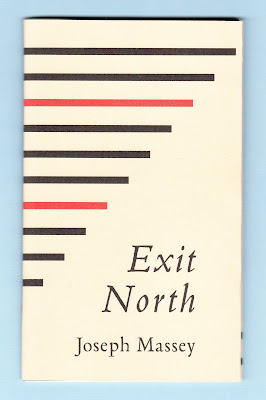
Exit North


Exit North, Joseph Massey’s new chapbook from Book Thug in Toronto, is his third little publication – following The Lack Of and Mock Orange – since Areas of Fog, his early 2009 (and first) full-length collection (which itself followed seven chaps).

Go Joe Go! With his love of the little book, and the rate he shares his work with the world, Massey might just reach – if he keeps on keeping on – the publication numbers of a, say, Cid Corman (more than 100 books and pamphlets) or Ted Enslin (approximately 70 so far). I say, bip, bop, bam alakazam may it come to pass if that’s what he wants!

I read an earlier version of Exit North about a year ago, via a pdf direct from Massey, and really liked it. The final published version, compared to that which I previously saw, adds two poems, slightly re-arranges the poems’ order, and changes – all to the end of a tighter focus – a few words in a few poems. The chap has 31 pages, 22 poems, and is smartly designed. It costs ten bucks (plus mailing), and is published in a first edition of one hundred copies.

Exit North is yet another Massey gem. It has the great little poems you’d expect from him, plus – and this here is some news – several (I count seven) poems which while still small and short relative to most poets’ work, are quite extended for Massey.

In last year’s Areas of Fog, which collected work from the previous five or six years, there were but two poems among its several dozen poems with more than 50 words (the longest had about 80), and those were extreme outliers. Most Massey poems are 20 or 30 words long, or thereabouts, and many have far fewer (for example, the poems in Brambles, a chap entirely included in Areas of Fog, are almost all 12 words or less).

Given that history of extreme concision, it’s quite notable that several poems in Exit North have around 50 or more words, and it’s huge that one of them – “A Line Made by Walking” – has 120 words and is thus I believe the longest poem Massey’s ever published. No, Joe hasn’t gone epic with his verse, not yet at least, but in this chap he does significantly lengthen some of it.

The other part of the story regarding the longer poems in Exit North is that they are just as gem-like as the shorter ones. I discuss a couple of the longer poems below so maybe you’ll see a bit more then but in the meantime I hereby conclude that the shorter and longer poems differ only in that the latter – as a logical consequence of the added words – have more facets, or a deeper vividness, to fascinate the reader.

+(+)+

If you’ve read Massey, you know he writes from where he’s at, and that a part of where he’s “at” is the North Coast of California, up around Humboldt Bay, where he’s lived for several years. I’m a sucker for that area, having traveled through there a lot – more than 50 times – between 1993 and 2007 and on several occasions since then. I can’t prove anything, but my mechano-receptors and synapses seem to ignite when I’m up there. Maybe it’s the salted air, the rush and recede of the sea, the fog and sun locked in the redwoods beneath a sky that moves, the bark of the sea lions and blasts of wind, or some other who-knows-what geodetic phenomenon, but when there that place kick-starts in me a mania of huge awareness, and vision gets mighty keen.

Exit North, reading it, gives me much the same gift of renewed (in)sight. It’s the place in the poems that does it, sure – the North Coast comes through, strong, via details regarding the qualities of its light, climate, flora, and geography details, but mostly it’s the Massey in the lines: his concision, precision, sound-sense, and the way the self, his mind-self, comes in. I’ve written about all that, or most of it, before, click here, here (scroll down a bit), and here if you please. For this post I’ll just say that Massey has an awesome thoughtful poetic awareness of what’s in his mind and of his emotions, as well as of the world around him, and it all comes through, beautifully and memorably in his words.

Sometimes, as in “After Last Night’s Drinking,” with its “patternless patterns,” “a child’s chalked hieroglyphics,” and “the noon siren” – plus other vivid details – Massey’s sober clarity is almost jaw-dropping. That there is a one hell of a hang-over poem: just about the whole goddamn bleezy perceptual-visual struggle – thoughts that “refuse,” “misremembrance,” things that “dissociate” or “blend” or “blur” – throbs through its 17 lines.

Also wondrous is “The Process,” which at just under 50 words is one of the longer poems in the book. Yes, it’s about poetry, the writing of it, and the waves in the mind, the crests and troughs of the world and one’s perceptions that come through in doing it, and which sometimes swamp the verse-work. Like just about every poem in Exit North, I’ve read this one over and over about fifty times and still find it something. Here it is, with its title and six tercets:

The Process

Cross-stitched
outside sounds
double the day’s

indoor confusion.
How to untwine
noise, to see.

There’s the bay,
highway slashed
beneath; water

a weaker shade
of gray than this
momentary sky’s

widening bruise.
The page turns
on the table, bare

despite all
I thought was
written there.

This poem is tight, and there are many points of accomplished genius. Start with the first sentence, which runs through the opening tercet and the first line of the second, and which in its few words contains multitudes of stuff. True, complications come about from the multiplication in the action-verb “double” in the third line, but that’s also there at the top, in the first line’s compound “cross-stitch,” an adjective that substantively highly suggests complication, and with its rich sounds (the “s’s,” “c’s” and “t’s”) make audible and thus pair perfectly with the “outside sounds” which it modifies. Then there is the quickness – an effect that results from Massey’s compression and concision – with which those “outside sounds” double up the “inside confusion.” My goodness, how much comes through in all that?

The language energy surge strong through the lines that follow that opening. The two lines that follow set out the central challenge: how to achieve clarity, to focus, amid all that’s about. The verb “untwine” seems particularly apt; it picks up on the “cross-stitched” and I think on “double” too, via the “untwin” embedded in it.

Massey then lays out a complex sentence that begins at the first line of the third tercet and runs to the first line of the fifth, and it kills. You can read it just as well as anyone; I love how he brings in the bay, highway, water, and the transitory (via “momentary”) sky with its “widening bruise” with nary a wasted word, and the way a kind of connected implicit violence comes through via “slashed” and “bruise.”

And then ladies and gentleman there is the parallel construction of the stanza-jumping, sentence-ending, two-word combinations that comprise the first lines of the second and fifth tercets. These enjambments create a kind of non-rhyming rhyme that brings together the “indoor confusion” and “widening bruise” in the lines.

The final sentence, comprising the poem’s last five lines, is a relatively simple statement about what’s not on the page, and the poet’s misapprehension about what isn’t there. I like the kind of tromp l’oeil effect, or is it the reverse of that? It’s not three dimensions depicted by two, but nothing (the “bare” page) shown by something (the final lines of “The Process”). Massey the Magnificent does it again.

+(+)+


A Line Made by Walking (1967)
Richard Long

The centerpiece poem of Exit North – it begins on the right side of the book’s middle – is “A Line Made by Walking.” Massey in an endnote states that his title is taken from Richard Long’s work.

Long’s work is a conceptual and process piece (documented by the photograph above) which he made by repeatedly walking a straight line in a grass field. He made his own path, going nowhere in particular but exploring relationships between time, distance, geography and measurement. The final product, the worn path and its documentation, is a sculpture of place, a distillation of experience.

Massey’s poem visually echoes Long’s work. It has 21 couplets, plus a concluding single line, and all lines are very short, with the longest having four with most having just two or three words. The thing, as it proceeds with its little steps, looks like a path made with words down its three pages. Here are the first half-dozen couplets:

Humid June
air that barely

moves, and yet
the water in the

creek wrinkles,
pushed around

fronds and
broken bottle,

or is it
chipped quartz

trapping the
glare. Rusted

[. . . ]
Notice that the sentence and line ends here are not congruent, keeping the poem moving. Note too how the two adjectives in the first line (“Humid June”) work both as a stand-alone concept and (due to the absence of a line ending comma) as a double modifier for “air” in the next line. But see most of all how the excerpt here looks on the screen, and imagine that relatively narrow column of words continuing for a couple more pages: a path made by lines stepped (walked) out by the poet, one after another.

I mentioned above that “A Line Made by Walking” is the longest poem Massey has published. And now that you are curious, I will not share any more of it here. You are going to have to buy the book, and you will do that, yes?

Interestingly, the 120 words of “A Line Made by Walking” do not read “long,” even for a Massey poem. The couplets move along smartly, and the mind never gets stopped by a word that’s not right, or out of place, because Massey’s concision, sound-sense, and poetic way with words never flag. There is plenty at which to marvel. And while the lines are essentially uniform in length, the six sentences embedded in them are not. The sentence-length pattern (long-medium-short-long-short-long) varies the poem’s pace, and that keeps attention taut.

It all raises the question of how long through the pages Massey might want to go. “A Line Made by Walking,” and the other more extended than usual poems in Exit North suggest he could write longer poems, without losing the gem-brilliance that marks his work. Well, to repeat what I wrote above, bip, bop, bam alakazam may it come to pass if that’s what he wants!

+(+)+


+(+)+


+(+)+
+++(+)+++
+(+)+


Sunday, June 20, 2010

“ . . . storms and

diatribes. Truffles and diamonds. Fables and ferns.”


John Olson’s recently published The Nothing That Is – a putative “novel” that’s in fact an autobiography written in the second person – shows again why I’ll follow him – his writing – anywhere. What an engaging and fun 150 pages, and oh the bits about poetry, and oh the poetry in the prose!

Because it’s written in the second person, The Nothing That Is comes across as a book that’s about you, the reader, while of course it’s really about Olson, the writer. The constant effect is to get you, the reader, to think about whether you agree with what’s said about you, and thus to get you (the reader) right there next to Olson’s views, experiences, and ways with words. Here are four paragraphs from very early on:
            You find bark grandiloquent with texture, like skin.
            You once enjoyed imbibing spirits but they got the
better of you, and it was either bid them goodbye, rid them
from your blood and being, or become a blob of mucous and
protoplasm erupting in vituperation at invisible interlocutors.
            You hate cars. They are destroying the world. But you do
love your own car, which is small and red.
            You have never seen an armadillo on a Texas highway
because you have never been to Texas, but you have seen deer
trot across a dirt road in North Dakota, an owl swoop down
against a red sunset in eastern Washington, a hawk circle a
meadow of cottonwood and poplar with the Wasatch range in
the background, and a fish of unknown identity leap, suddenly,
from Moses Lake on a bright summer afternoon.
See what I mean? What do you think, how do you feel, about, bark, drinking alcohol, and cars? What animals, birds, and fish have you seen while driving? How would you put those thoughts and experiences in words? Olson in this way strongly exploits the implicit second person narrative tone, not so much the accusatory facet of that, but that which places the reader in unfamiliar or new circumstances. Throughout the book, you are there, with him, in his life. It’s invigorating, and of course also banishes entirely the “I” which egotistically grates in many autobiographies.

The Nothing That Is was written and mostly covers events over several months in 2006, although naturally enough much from Olson’s past gets mentioned or recounted. As such, you’ll learn a bit about his mom and dad, how he met his current wife, and the details – strangely fascinating – of how he waits for her to get off work in the parking lot of the supermarket in which she decorates cakes. You’ll find out what he thinks about SUVs, hip-hop, apathy, noise, his neighbors and a hundred other things. You’ll read about the time in 1966 he bought Jimmy Page (yes, that Jimmy Page) a Coke, the habits of his cat, and the invasion of carpenter ants in the building where he now lives. Digressions musing on, for example, the postman’s hands, the car Montaigne would drive, the full moon in the daytime sky (Jack Spicer comes into that one), and how resignation can be a wonderful thing. All this, as they say, and more. In short, if you want to get to know John Olson – and heads up to those in New York City, he has a Poetry Project reading coming up this fall – this is one tremendous introduction.

The Nothing That Is mostly takes place in Seattle, where Olson has lived for decades, but there’s a great 35 page swath just after the middle of the book – so engaging it almost serves as the novel’s centerpiece – that concerns a road trip to Missoula, Montana. Also, while place names remain true to the actual, most people mentioned are given swapped out names, in the manner of a roman à clef. However, some of these – such as Olson’s wife, and the poets Andrew Joron and John Yau (for whom Olson provides tremendous capsule descriptions of their writing) – are fairly easy to decode.

The book’s title comes from the final words of Wallace Steven’s great poem, “The Snow Man” (the poem’s set out in full opposite the first page). I can’t here fully boil down Olson’s concept of “the nothing that is” but it does – per what’s in the book – relate to Zen no-mind:
            You try not to make judgments but focus intensely
and openly at what is there, there in its actuality, there
without any overlays of personal value, skewed perceptions.
The dimming light of late afternoon in late winter, the yellow
arrows of the parking lot, one curving round the other two
pointing straight ahead, the imperceptible changes in the
clouds, the crown of the Space Needle poking above Fed
Ex Kinko’s, the light distortions of repaired dings in the
windshield, the diamond pattern on the wall of the drugstore, a
flock of seagulls, the pliable indentations in the steering wheel
that are nice to squeeze, you absorb yourself in all these things
and try to bring some peace into your body, some detachment,
some compassion, not to have any thought stirred by the
outside conditions of life, good and bad.
Sort of the flip side to this no-mind ideal is anger and rage. Olson has his moments this way, and those moments are INTENSE. The upstairs neighbors are particular focal points, and at times it scares me how mad Olson gets (the provocation can be severe). Olson never acts on what goes on in his mind, questions sincerely and smartly the hows and whys of it, but if his thought-dreams could be seen, they would indeed probably put his head in a guillotine. It’s pretty courageous, I think, for Olson to show this much of this part of himself.

Among all else in The Nothing That Is are several passages directly about writing, and the writing of poetry in particular. Olson at one point in the book just comes right out with it, stating in no uncertain terms what it is he’s looking to do with poetry, and how it differs from what else is out here:
              [ . . . ]        You favored a type of poetry that
was wild and surreal. A poetry full of phantasmagoria and
fugitive meaning. The poetry of delirium. A poetry that did
not point in one direction but in many directions. A poetry
that capitalized on the inherently hallucinatory properties
of language. It had been your experience that most people
did not care for this type of poetry. People preferred a more
transparent poetry which presented a single lyrical emotion in
an anecdotal setting. The bland and acceptable poetry which
was generally featured on NPR, read by Garrison Keillor, and
got all the NEA grants.
Olson a bit further along also describes his approach in an equally tasty, but perhaps more bite-sized set of two sentences:
[ . . . ]    Writing things that do not instruct or inform so much
as diffuse into the blood and nervous system creating feelings
of disquiet and euphoria. The sound of heaven made actual as
skin.
And then, also further along, there is the following passage that’s a bit – make that a lot – more tactile and poetic, and thus which while explicating the approach to writing also imparts the wonder that comes when Olson works the words right:
            Your day is a long monologue. Words galore. Your pen
is a leopard moving with stealth through a lush vocabulary of
brawling vines and exotic bullfrogs. You are Prospero with his
staff. You conjure storms and diatribes. Truffles and diamonds.
Fables and ferns. The machinery of signification. Monsters of
howling malcontent. Maraschino dots like scabs of coagulated
thought.
Storms and diatribes, truffles and diamonds, fables and ferns. Hmmm, and yes, I think that, the series of coupled nouns there, just about covers it, says just about exactly what you’ll find in The Nothing That Is, a novel autobiography that’s everything I hoped it would be.

+(+)+

“The Snow Man”
by
Wallace Stevens


[recited by James Merrill]

+(+)+

John Olson regularly posts his reviews and prose poems at Tillalala Chronicles. Other recent prose poems by Olson are posted at Alligatorzine. I’ve previously published Olson’s essays on, respectively, aliteracy, extreme reading, and hard-copy books, and have previously written on Olson’s non-literary essays, his poetics, and his most recent poetry collection, Backscatter. Another collection of Olson’s poetry, titled Larynx Galaxy, will be published late this summer by Black Widow Press.

+(+)+
+++(+)+++
+(+)+


Wednesday, June 16, 2010

. . . and

yes

I

said

yes

I

will

Yes.


Saturday, June 12, 2010

The Return of Ron . . .

. . . to Poetry


Ron Silliman
“from
Revelator
in
Poetry
(June 2010)
[cover image altered, natch, via PhotoShop]


Well, what do you know: this month, after an absence of 41 years, poet Ron Silliman’s work – in the form of a long excerpt from his poem Revelator – appears again Poetry magazine. Silliman’s previous and only other appearance in the ‘zine came in 1969, the year his first book was published.

No, nobody’s going to write an epic, a la Odysseus and Penelope, about this particular return. Nor is Silliman here some sort of poet Tommy Thevenow, the major leaguer whose first home run in 1926 was not followed by another until 1938, 12 seasons and 3,347 at-bats later (that’s the record); Ron’s had plenty of round-trippers over the decades. But still, this may be the record, or close, for most years between appearances in the grand dame of American poetry magazines.

Anyway, I wanna talk about “from Revelator,” the Silliman poetry that Poetry published. It’s ten excerpts, amounting to approximately 465 lines (each with exactly five words) and 14 printed pages in the hard copy ‘zine.

But first, permit me dear readers of the glade to opine a bit regarding the po(etry)litics – by which I mean the significance – of Silliman being published in Poetry after so many years. It’s come about, I think it fair to say, as a result of Poetry’s recent move towards a more catholic approach to the possibilities of today’s poetry. For a long time – some would say since Henry Rago was editor (he died in 1969) and at least the last approximately 20 years – Poetry, the work published in it, has been – with a few notable exceptions (e.g., John Ashbery) has been decidedly uncomtemporary (as Silliman himself implied three years ago) and (my term here) awfully dull.

But in the last three years or so Poetry has broadened what it publishes. Poets and poems that you wouldn’t (and couldn’t) find in it twenty, ten, or even five years ago now appear just about every month. Look who has turned up in the ‘zine since 2007 or thereabouts (these are examples): Rae Armantrout (in five different issues), Fanny Howe (a couple times), a bunch of Flarfers + Conceptualists (a special section), Charles Bernstein (thrice), Ange Mlinko (a dozen or so separate time, a laudable instance of editorial enthusiasm unleashed), Inger Christensen, Robert Hass (the longish + disjunctive “September Notebook: Stories”), Juliana Spahr (a manifesto), and a large number of vis-po work (another special section, edited by Geof Huth).

As such, this month’s – drumroll, please – Return of Ron continues the magazine’s attempt to become a forum for new work from poets who write in ways decidedly different than the quieter staid verse that it primarily and even entirely featured in far too many issues for far too many years.

For this most welcome change I credit senior editor Don Share (he began at the ‘zine in October 2007), his boss Christian Wiman (who seems to have given Share room to move), and associate editor Fred Sasaki (who no doubt does a lot of the work). But whoever has made it happen, I celebrate the move towards presenting writing of a kinds different than its own recent tradition, to take a course that might (or plainly will) cause concern among that part of Poetry’s subscriber or readership that’s too often been inured to the fuddy-duddy.

Yes, “inured to the fuddy-duddy.” That’s what I say about those who – to take just examples from readers’ letters published in Poetry so far this year – find an esoteric allusion “solipsis[tic],” deplore “gutter language and “naughty children,” consider themselves “average Joes,” believe that poetry now finds itself in a “lowly state,” or find ampersands and “Dickinsonian dashes” distracting.

Hello? Dear people inured to the fuddy-duddy: wake up, please, and smell the kaliedoscope as it tickles your proprioception!

Now don’t get me wrong. Poetry’s recent efforts to expand its variety is but a start. There are at least fifty other poets – and that’s just off the top of my head – that should be published there, before the ‘zine can righteously be considered to have approached the wondrous range of today’s out-there and with-it writing. I hope Poetry’s editors actively solicit wide and far, and that poets I’m thinking about give it a shot.

Poetry, let’s face it, is well-positioned to attract poets of all kinds, in that unlike many journals it pays, and pays relatively well. At its standard rate of ten dollars per line, Silliman for example presumably received close to $5,000 for “from Revelator.” That’s a nice chunk of cash (although given the length of the excerpts, and their placement at the front of the issue, I hope Poetry applied a generous multiplier to Silliman’s payment). The Poetry Foundation has the money, and if they can build a $25 million headquarters and a million dollar website they can kick down a little more to the poets. So, go Poetry: keep paying the poets, and please: less pap, more inventive and visionary.

Poetry it seems to me is trying to become a kind of monthly big-tent three-ring verse-circus (and don’t forget the prose-poets, please). This is not a bad goal, it sounds fun as hell, but whether this can work or not in practice, I’m still not sure. Sometimes it’s really, really weird. Next month’s (July/August 2010) issue, whose table of contents and one essay are already available on-line, shows what I mean. It includes among other things two poems by the fresh, neo-surrealist, and riveting Sandra Simonds, to which I say yes!, and a poem by Anthony Madrid titled “In Hell the Units Are the Gallon and the Fuck” that I’ll wager will be a very lively read.

But next month’s Poetry will also include a portfolio of work by Robert Pinsky about which, sorry, I’m betting will strike me as populist doggerel [note: on 6/14, I learned via a blog post by Poetry editor Don Share that it’ll be a libretto, not poems by Pinsky]. Even worse, Poetry will feature an essay – I call it a stink-pile – on poetry by John Wooden, the just-dead ultra-conformist college hoops coach. The essay is already on-line (click here, but I warn you), and in it Wooden explicates a view of poetry as interesting and useful as a deflated basketball. Hallmark greeting cards are better than the verse quoted by Wooden in the essay. Crap like this shouldn’t be allowed in any tent, no matter how big and no matter how much inventive and experimental work is included.

But let’s get back to Silliman’s “from Revelator.”

+(+)+

The 14 pages of excerpts from Silliman’s Revelator in the June 2010 Poetry amount to about 25% of the completed poem, according to information Ron kindly provided in response to an e-mail query. An interesting question, to me at least, is why were the particular poem-segments printed in the issue – and again, there are ten – chosen?

There’s little doubt that the excerpts were carefully selected. They are taken from different parts of the poem, and are not simply consecutive to one another (as can be deduced by listening to a reading by Silliman from earlier this year). Further, the excerpts vary in length. The longest is 84 lines (three others have more than 50), five have between 30 and 45, but one is but seven lines long. That short one got me started here – why those lines, and only those?, I asked myself – and from there the same but broader question: of everything in the poem, why these particular excerpts?

My answer is but a guess, a speculative assertion. However, I think it’s a good guess, and besides, by offering my two cents the poem, that which is at its core, can be focused on, which should be the main point here.

So here’s what I think: Revelator is a great poem, and the excerpts in Poetry were chosen
both because they are representative samples and include enough of Silliman’s core poetic / aesthetic / philosophical precepts (embedded in the lines) such that those new to his work – including that segment of Poetry readers that I call fuddy-duddies – might learn and see (assuming they give it a good honest read) what he’s up to as a poet, and might have their eyes and minds opened to its power and importance. The excerpts, in short, serve as a not quite but sort of a primer and/or prolegomenon to Silliman’s poetry, something that might be instructive to readers not yet familiar with it.

It’s “not quite but sort of” a primer because the principles presented even when overt are embedded in the lines, and sometimes presented as object lessons. But pointers about and examples illustrating what’s going on are there, and readers who don’t know Ron’s writing, who might be used to more explicitly narrative or bow-tied poems, are given plenty of signposts.

At the core of Silliman poetry – more accurately, the Silliman I’ve read over the years – is an intense focus on the present, the now. It’s something he learned first while working with prisoners in the early 1970s (see the note at the back of Circle “R” (Drogue Press, 1995), written in the third person but clearly Silliman’s own, and the section appended at the bottom of this post). For those doing time, yesterday and tomorrow aren’t nearly as relevant – to say the least – as today (this convict-view in Silliman deserves greater exploration, and someday I may well do so). The point though, is the NOW, and keeping the mind attuned to it.

And so in the first excerpt from Revelator in Poetry, a few lines into it, there’s a mention of a movie, about which Silliman writes:
              . . . plot too
dense to follow, unless (unless!)
mind’s eye gives attention . . .
And there it is, the importance of attention, a pretty dang direct mention at that, and emphasized too, via the repetition and exclamation-pointing of the qualifier-conjunction.

And so too, in one of the later excerpts (I’ve added italics here is underscore my reference):
                  . . .young man
alone in Chipotle, chewing thoughtfully
his large burrito, not talking
taking it all in, eyes
absorbing all, could have been
had this taqueria been there
then, myself in 1964 . . .
I like the repetition of “all” in this excerpt, in that it again emphasizes the goal, the approach of the poet, and the fact that the principle set forth – Silliman’s thinking about what’s going on, his projection of self into the observed – is embedded in a detail (the guy with burrito), an instance of exactly the kind of particular that results from the focus on the now, and a detail and principle that – because it is presented in six concise and carefully constructed but almost nested-in-one-another clauses – requires from the reader the precise kind of attention that Silliman enacts and champions!

The “from Revelator” excerpts in Poetry also include lines and phrases in which Silliman comments about his process or approach, which also give the reader an orientation to his work. There is, for example:
                  . . . what’s near
is past too soon to
grasp fully the consequence, dawn
threatens a new day constantly
which seems to set forth the constant challenge of focusing on the now, and (this from the excerpt that’s but seven lines long):
              . . . —there’s an art
to it intuited before thought
thinks— . . .
which says something about how Silliman deals with the challenge of the cascade of moments. And then there’s this statement, the last example I’ll present (read the excerpts in Poetry, available on-line, to find more!), in which Silliman explains that his poetic adventure will never be finished and at the same time directly tells what he’s doing, as he does it (note the effect of the line break after “stretch”):
               . . . one project
I’ll not complete, that’s not
it’s point, but to stretch
even just a little, shape
& dimension, time & dominion,
+(+)+


“After [his] early books [Crow], nox and Mohawk, Silliman began to understand the most important lesson of his work with prisoners – that there is no time other than the present – and began to apply it to prose in a poem called Ketjak. This lesson and that project have subsequently extended into a life work, in which each poem is at once distinct and always also part of a much larger process.”
– from the editorial material near the rear of Silliman’s
Circle “R”
(Drogue Press, 1995)
(+)

“Tomorrow’s a dream
Yesterday’s a memory
Both a passing of a cloud”
– from “No Beauty In Cell Bars”
a poem by Spoon Jackson
in
About Time III:
A Third Anthology of California Prison Writing
(Prison Arts Project, 1987)


+(+)+
++(+)++
+(+)+